
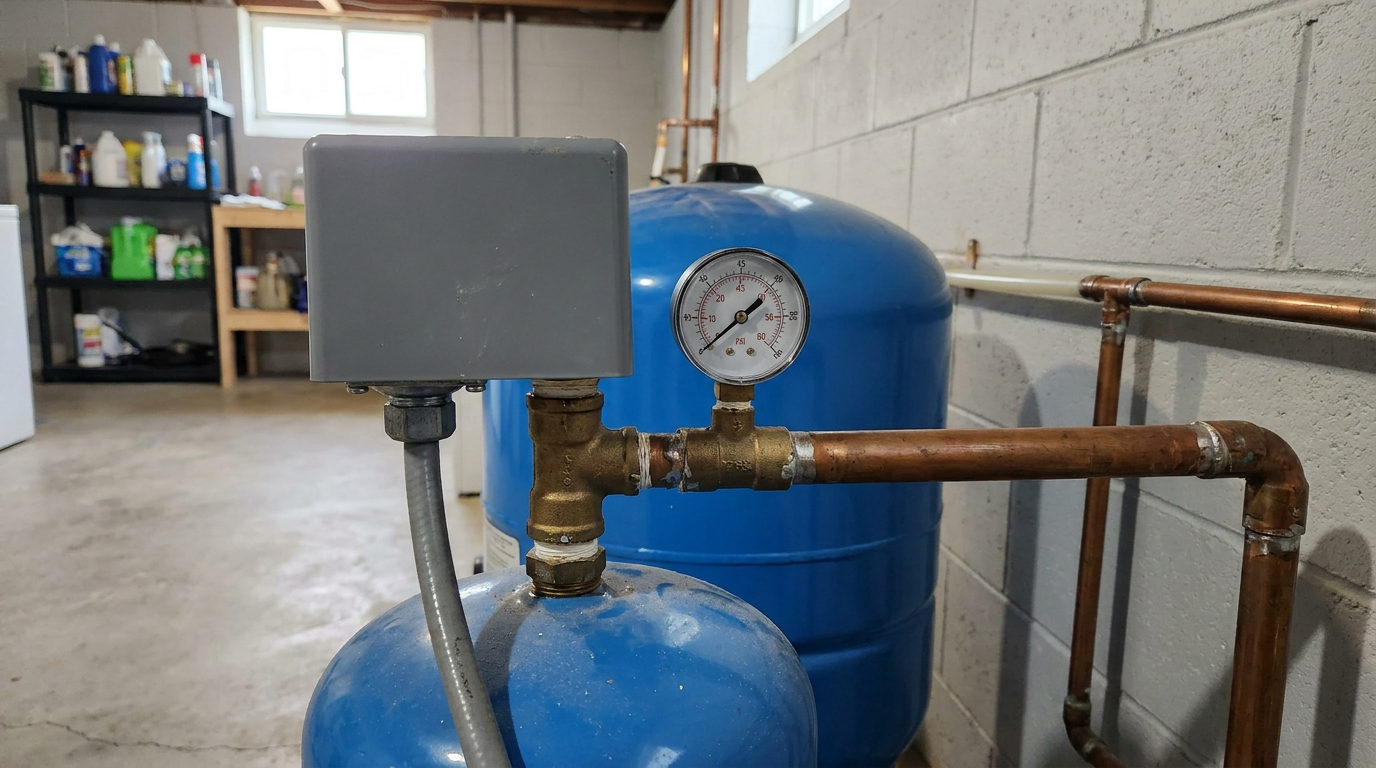
Well pump pressure switch problems can cause a pump that won’t start, won’t stop, or runs intermittently — but those same symptoms can come from the pressure tank, the switch’s own sensing path, the pump or control box, or the power supply. The useful question isn’t “is the switch bad?” It’s “what does the pressure behavior actually point to?”
This guide walks through the observations you can make safely — the gauge, the sound, the outside of the switch — and what each one does and doesn’t tell you. It also explains why some systems don’t use a conventional pressure switch at all.
One boundary holds throughout: the switch cover stays on. The enclosure carries line-voltage components, and everything here is based on gauge behavior, sound, external observation, and system type — not live electrical testing.
First, Make Sure Your System Actually Uses a Conventional Pressure Switch
Most of this guide applies to a conventional mechanical pressure switch. Not every well system has one, and starting here saves you from chasing symptoms that don’t apply to your equipment.
Conventional mechanical switch: a small enclosed switch mounted on a short nipple or fitting connected to the tank tee near the pressure tank — no display, no buttons, just an enclosure with conduit or cable entering it. Many residential systems use enclosed switches such as Square D/Pumptrol-style units, but that’s an example, not a rule; your switch’s own markings are the reference that matters.
Conventional switch with a low-pressure cut-off lever: the same enclosure, plus a small external metal lever on the side, indicating a low-pressure cut-off (LPCO) feature — covered below. It doesn’t change how the rest of this guide applies.
Constant-pressure / VFD system: a larger controller box with a display or status lights — for example a Franklin Electric SubDrive-type system. Here the controller, not a line-voltage switch, manages pump speed. The sensing device may be a low-voltage sensor or, on some systems, a pressure transducer — which one your system uses isn’t something to assume. Most of the logic below does not apply here; the manufacturer’s manual, or a professional familiar with that controller, is the right next step.
If your main symptom is rapid, rhythmic cycling regardless of system type, our well pump short cycling guide covers that pattern in depth.
What a Well Pump Pressure Switch Actually Does?
A well pressure switch is a pressure-operated electrical switch, not a pressure regulator. It responds to system pressure by opening or closing the circuit that controls the pump — the pressure mechanically actuates the switch, and the switch controls the electrical side.
Cut-in: as pressure falls, it reaches a set point where the switch closes and calls for the pump. Cut-out: as pressure climbs back up, it reaches the point where the switch opens and stops the pump.
Pressure reaches the switch through a small nipple from the tank tee to its internal diaphragm. If that passage silts up with sediment, iron, or scale, the switch stops reading actual system pressure. A blocked sensing path can make a healthy switch behave as though it were defective — a documented cause of a switch that won’t call for the pump. Confirming or servicing a blocked sensing path requires access beyond the homeowner checks in this guide.
Switches are described by pairs like 20/40, 30/50, or 40/60 — roughly cut-in and cut-out. Pentair’s Myers line documents all three as available factory ranges — context for how much these vary, not a suggestion one is correct for you. Your own switch’s rating, printed on it, is what matters.
The pressure tank is part of the same picture: its air pre-charge is set relative to cut-in. Amtrol specifies a well-tank pre-charge 2 PSI below the pressure-switch cut-in setting for its well tanks — a manufacturer-specific figure, not a rule for every tank design. When that relationship is off, the tank can produce symptoms that look exactly like a switch problem — the subject of the comparison section below.
Signs of Well Pump Pressure Switch Problems
None of the following, on its own, confirms the switch has failed. Each has at least one likely explanation that has nothing to do with the switch.
Pressure falls below the expected cut-in and the pump doesn’t start. Could point to the switch or its sensing path, a tripped low-pressure cut-off, an upstream power problem, or a pump/control-box fault — or, before any of those, a gauge that isn’t reading correctly. It narrows the field; it doesn’t identify the cause.
Pressure reaches or passes cut-out and the pump keeps running. Possible causes: a switch or sensing problem, a mismatched setting, an inaccurate gauge, or another pump/control issue. If pressure is climbing past where it should stop, turning the pump off at the breaker is a reasonable protective step before professional diagnosis — not a diagnosis in itself.
Rapid clicking or chatter. Gets its own short section below — briefly, a system-wide symptom with several likely causes, covered in depth in our short cycling guide.
Intermittent operation — works sometimes, doesn’t others, no obvious pattern. Can point to an obstructed sensing path, a sticking or worn mechanism, or another electrical/control problem. It’s a strong reason for inspection — it is not proof the switch needs replacing.
The switch clicks but the pump stays silent. Moves the investigation toward the switch’s electrical output, the pump/control box, or the power path. A click tells you something moved mechanically; it does not confirm the electrical side is working, and shouldn’t be read as evidence the switch is fine.
The breaker trips when the pump tries to run. A stop-work signal, not a troubleshooting step. Leave it off and arrange professional diagnosis rather than resetting it repeatedly.
Water at or around the switch. Also a stop-work signal — shut the pump off at the breaker and call a professional.
Visible external corrosion, rust staining, or insect activity. Suggestive of age and a damp environment, but doesn’t tell you whether the switch works. The cover stays on either way.
What Each Symptom Suggests, and What It Doesn’t Prove?
Read this table as a whole, not symptom by symptom. Notice how often more than one branch applies — that’s the real pattern in well-system troubleshooting, and why a single symptom rarely settles anything.
| Observation | What it suggests | What it does NOT prove | Next safe step |
|---|---|---|---|
| Rapid clicking / chatter | Tank pre-charge, a leak, a check valve issue, or a sensing problem | That the switch has failed | See our short cycling guide |
| Pump won’t start, pressure below expected cut-in | Switch/sensing issue, low-pressure cut-off, power problem, or a pump/control fault | Which of those it is | Check the breaker and any LPCO lever, then arrange professional diagnosis |
| Pump won’t stop, pressure above expected cut-out | Switch/sensing issue, a mismatched setting, or a stuck/inaccurate gauge | That the contacts are welded closed | Turn the pump off at the breaker; arrange professional diagnosis |
| External low-pressure cut-off lever latched off | A low-pressure event triggered the switch’s protective trip | That the switch itself has failed | Find out why pressure dropped before treating the lever as the fix |
| Pressure gauge doesn’t move | A failed gauge, a closed valve, a dry or low well, or a pump that isn’t pumping | Anything about the switch — the gauge reading can’t be trusted yet | Confirm the gauge itself before drawing any other conclusion |
| Short cycling with a clean cut-in / cut-out | Makes the tank/pre-charge branch more likely | That the switch is fully healthy | See our short cycling guide and the Pressure Tank Calculator |
| Intermittent operation | An obstructed sensing path, a sticking/worn mechanism, or another electrical/control issue | That the switch specifically needs replacing | Arrange professional inspection |
| Single click, then the pump stays silent | The switch’s electrical output, the pump/control box, or the power path | That either the switch or the pump has definitely failed | Professional electrical diagnosis |
| Visible external corrosion at the switch body | Age and a damp environment | Whether the switch is working | Note it; leave the cover on |
How to Tell a Pressure Switch Problem From a Pressure Tank Problem
This is usually the more useful question. A functioning pressure switch responds to the pressure it senses in the pipe. Before blaming the switch, ask whether the pressure itself is behaving normally — and whether the switch is receiving an accurate pressure signal.
Tank / pre-charge pattern: pressure climbs to cut-out quickly, then falls back to cut-in within seconds — very little usable drawdown. Or: a real cut-in and a real cut-out, cleanly repeated, just far more often than it should be. That second pattern is worth calling out specifically — a clean, repeatable cut-in-and-cut-out cycle that’s simply too frequent makes the tank/pre-charge branch more likely and a switch fault less likely, but it does not independently confirm that every part of the switch is healthy. If this matches what you’re seeing, our short cycling guide covers the tank side, and the Pressure Tank Calculator can help once a tank issue is suspected.
Switch / sensing pattern: chatter clustered around one pressure rather than a clean cut-in-to-cut-out rhythm; pressure clearly outside the expected switching point with no response; an intermittent pattern unconnected to water use; a low-pressure cut-off condition (below); or a known history of sediment, iron, or scale — a documented cause of a blocked sensing path. None of these confirms failure; they point toward the switch as the more likely branch, with professional confirmation still needed.
Pump / electrical / control pattern: a click with no response, a breaker that trips on start, a motor that hums without pumping, or a control-box fault. These point toward the pump, wiring, or power path — our well pump not working guide covers that branch.
| Pattern you observe | Tank / pre-charge | Switch / sensing path | Pump / electrical |
|---|---|---|---|
| Clean cut-in/cut-out, cycling far too often, little drawdown | Points toward this branch | Still possible | Not specifically indicated |
| Chatter clustered at one pressure, no clean cut-out | Still possible | Points toward this branch | Still possible |
| Pressure below cut-in, pump silent, no chatter | Not specifically indicated | Points toward this branch (switch, sensing, or LPCO) | Still possible |
| History of sediment, iron, or scale in the water | Not specifically indicated on its own | Points toward this branch (possible blocked sensing path, not confirmed) | Not specifically indicated |
| Switch clicks, pump stays silent | Not specifically indicated | Still possible | Points toward this branch |
| Breaker trips on start attempts | Not specifically indicated | Still possible | Points toward this branch |
| Motor hums, no water delivered | Not specifically indicated | Still possible | Points toward this branch |
These patterns narrow the possibilities; they do not confirm a failed component. Tank, switch, and pump/control faults can also coexist, so finding evidence for one branch does not automatically rule out another. Confirming which component actually failed requires measurements inside the circuit, which this guide does not walk homeowners through.
Why the Pressure Switch Keeps Clicking?
One click as the pump starts at cut-in and one as it stops at cut-out is normal, quiet in between if nobody’s using water.
Rapid clicking or chatter can come from pressure instability elsewhere in the system — including tank/pre-charge problems or a sensing issue, so the sound alone doesn’t prove that the switch has failed.
Determining what the contacts are doing would mean opening the enclosure while powered — beyond the checks here, and treated by the manufacturer’s own instructions as service work requiring power disconnected first. If clicking is rapid and rhythmic, our short cycling guide is the right next stop.
When the Pump Won’t Start?
Check without opening anything: What does the gauge read? Is the breaker on? What position is the LPCO lever in, if you have one? Any visible damage or leakage?
If the gauge is trustworthy and pressure is clearly below cut-in but the pump never starts, the switch/sensing/power branch deserves investigation; but it still doesn’t tell you which component failed: the switch, a blocked sensing path, a tripped low-pressure cut-off, a power problem, or a pump/control-box fault are all still possible.
If you hear a click but nothing happens, that moves the investigation toward the switch’s electrical output, the pump/control components, or the power path, distinguishing among them requires professional measurements, not further diagnosis from outside the enclosure.
If there’s no water anywhere and you haven’t ruled out simpler causes, our well pump not working guide is the broader starting point.
When the Pump Won’t Shut Off?
A few things can cause pressure to keep climbing past cut-out without the pump stopping: a switch or sensing-path problem, a mismatched setting, a stuck gauge, or another system issue.
Don’t wait this one out. Turn the pump off at the breaker and arrange professional diagnosis, running past intended cut-out stresses the tank, plumbing, and pump. Our well pump not working guide covers the broader runs-constantly pattern alongside this case.
Low-Pressure Cut-Off Switches and Reset Levers
Some mechanical pressure switches include an external lever, a small metal arm on the side — that’s part of a low-pressure cut-off (LPCO) feature. You can identify it from the outside; nothing needs to be opened.
The lever’s job is protective: it responds to a loss of system pressure – a drawn-down well, a lost prime, a failed check valve, a leak, or a frozen line – by keeping the pump from running dry.
Exactly how it behaves is specific to the switch. As one documented example: on a Square D 9013F with the M4 option, the cut-off engages 10 psi below cut-in, and the switch latches into a maintained-off state with no automatic recovery — it stays off until the lever is manually held in start. These values and this behavior are model-specific; don’t assume they apply to a different switch.
For the Schneider M4 example, the manufacturer’s sequence is explicit: correct the system fault first, then reset. More broadly, repeatedly resetting any low-pressure protection without understanding why it tripped is not a sound troubleshooting strategy. If the well is low or a leak hasn’t been found, resetting just lets the pump run into the same condition that tripped it. Repeated resetting without addressing the cause defeats the protection the lever exists to provide.
What if my well pressure switch has no reset lever? There usually isn’t a manual reset procedure to perform at the switch. A pump that still won’t start needs diagnosis of the actual cause rather than a hidden “reset” inside the enclosure, not something to pursue by opening the cover.
We’re intentionally not walking through the reset procedure itself, the mechanics vary by switch, and doing it safely starts with identifying your specific model. Use the instructions for your specific switch model or have a qualified well professional handle the reset if the cause of the low-pressure event is unclear.
A Safe Step-by-Step Way to Check
- Stop for obvious hazard signs. Breaker keeps tripping, water in the switch, a burnt smell, a damaged enclosure — pump off at the breaker, call a professional.
- Identify your system type. Conventional switch, switch with an LPCO lever, or constant-pressure/VFD controller.
- Name the symptom precisely. Won’t start, won’t stop, intermittent, rapid clicking, a click with no response, or unusual gauge behavior.
- Check whether the gauge is trustworthy. Does it move at all? If it seems stuck, don’t trust its reading yet.
- Check water demand and the cycling pattern. Anything running? A clean cycle that’s just too frequent points toward the tank.
- Check the LPCO lever, visually. If latched, the question is why pressure dropped — not how to flip it back.
- External visual inspection, pump off at the breaker. Corrosion, rust, water, damaged tubing, insects. The cover stays on.
- Stop here. Cover off, contact inspection, the sensing nipple, settings, electrical measurements, replacement — all professional territory from here.
What You Can Check Yourself and What You Shouldn’t?
You can safely: read the gauge and note its behavior over a cycle · listen for a single clean click versus chatter · check whether water is running anywhere · look at an LPCO lever’s position · check the switch’s outside condition · confirm whether the breaker is on or tripped · turn the pump off at the breaker as a protective step · identify whether your system uses a conventional switch or a controller. A tank pre-charge check is a tank-side check, our short cycling guide covers it.
Professional territory – not out of caution for its own sake, but because it involves line-voltage components, pressurized plumbing, or both: removing the cover, inspecting or cleaning contacts, voltage or continuity testing, jumpers or bypasses, forcing contacts, capacitor testing, breaker-panel work, wiring, adjusting settings, servicing the sensing nipple, and replacement.
The manufacturer’s own service instructions are direct on this. Schneider Electric’s current instruction sheet for its Pumptrol-line switches states: “Disconnect all power before wiring or servicing… Install and secure the cover before restoring power. Failure to follow this instructions will result in death or serious injury.” That’s why this guide stops where it does.
Many guides answer “how do I test it myself?” with voltage or continuity checks made inside the switch. We don’t publish that procedure, confirming electrical operation means working on the same components the instructions above say to de-energize first. A professional can safely make those measurements; that step isn’t part of this guide.
About Pressure Settings and Why This Guide Won’t Tell You to Turn the Screws?
Switches are described by pairs like 20/40, 30/50, or 40/60, roughly cut-in and cut-out. These are common factory ranges, not a fixed standard, and none is inherently “better.”
Two things matter more than the numbers: your tank’s pre-charge is set relative to cut-in, so changing one without the other throws off that relationship; and correct settings depend on your specific switch, pump, and tank, not a general rule.
For those reasons, this guide doesn’t walk through adjusting a switch’s range or differential — done with the cover off, under line voltage, in a sequence that varies by switch. If a misadjusted setting turns out to be part of what you’re seeing, changing it safely is a separate topic from diagnosing it.
When the Pressure Switch Actually Needs Replacing?
A few patterns lead toward replacement: a switch a professional has confirmed has failed, a mechanism that’s worn or sticking regardless of the sensing path, or physical deterioration alongside a confirmed electrical fault.
Keep the branches separate, though. A blocked sensing nipple may only need servicing, not a new switch. A tank problem doesn’t call for switch replacement. A pump, wiring, or control-box fault won’t be fixed by replacing the switch either.
We’re not covering the replacement procedure, parts, or cost here. If diagnosis points to the switch, a licensed well or pump professional can confirm it and handle the replacement.
FAQ
How do I know if my well pump pressure switch is bad?
Well pump pressure switch problems are best identified by the pattern, not one symptom: pressure below cut-in with no start, pressure past cut-out with no shutoff, chatter at one pressure, or intermittent operation unconnected to water use all point toward the switch. None proves it alone — a professional confirms it with measurements this guide doesn’t cover.
What happens when a well pressure switch fails?
It can fail to call for the pump, fail to stop it, or behave intermittently — but a tank, pump, or control/power issue can cause the same symptoms.
Will a well pump work without a pressure switch?
Not in the conventional sense. Constant-pressure/VFD controllers manage pump speed electronically instead, using a low-voltage sensor or, on some models, a pressure transducer.
Can a bad pressure switch cause short cycling?
Yes, but pressure-tank and pre-charge problems are also common causes of short cycling. A clean, rhythmic cut-in/cut-out cycle that repeats too frequently points more strongly toward the tank side of the system. See our short cycling guide.
Can a clogged pressure-switch nipple cause problems?
Yes — sediment, iron, or rust blocking the nipple is a documented cause of a switch that won’t call for the pump. Servicing that passage is a job for a professional.
Can a bad pressure switch trip the breaker?
Treat a tripping breaker as a stop-work signal, not a clue pointing at the switch specifically. Leave it off and get it looked at.
How long does a well pressure switch last?
No reliable universal figure — lifespan depends on water quality, cycling frequency, and the switch itself. Watch for the patterns above instead.
Can I replace a well pressure switch myself?
We don’t publish a replacement procedure — it combines line-voltage work with pressurized plumbing and matching the switch to your pump and tank. A licensed professional is the right next step.
Why did my well pump stop after a power outage?
On a switch with a low-pressure cut-off, a pressure drop during the outage can latch the lever off, and it won’t clear on its own. That’s specific to switches with that feature — see the section above.