
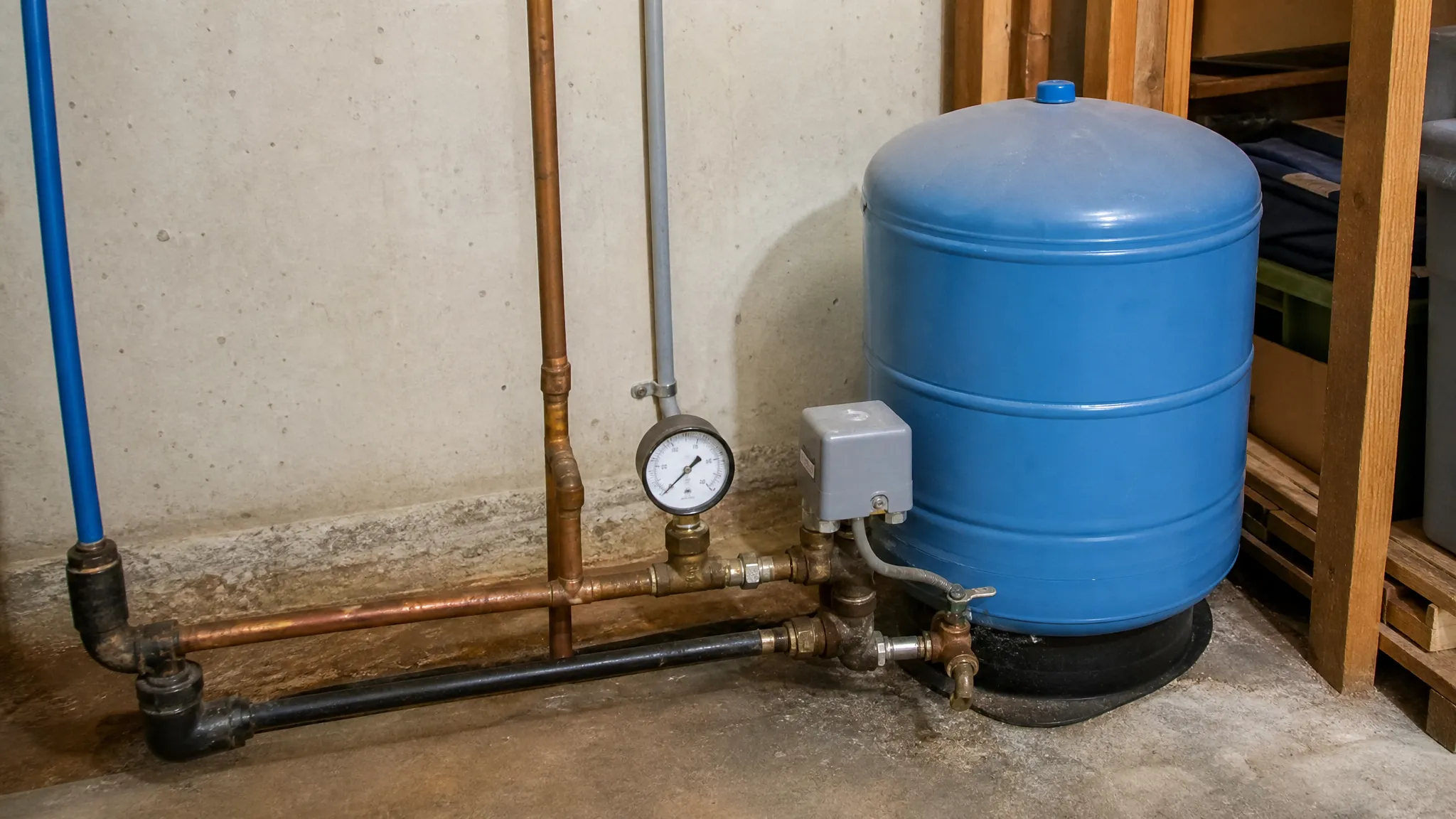
Well pump short cycling means the pump is starting, running only briefly, shutting off, and starting again far sooner or more often than the system was designed for. It's usually traced back to the pressure tank — but not always, and the fix depends partly on what kind of system you actually have. This guide walks through how to confirm what you're seeing, the most likely causes in order of how common and how checkable they are, and where to safely stop and call a professional.
If your pump won't run at all, produces no water, or runs continuously without ever shutting off, this isn't the right guide — see Well Pump Not Working instead.
How to Tell If Your Well Pump Is Actually Short Cycling
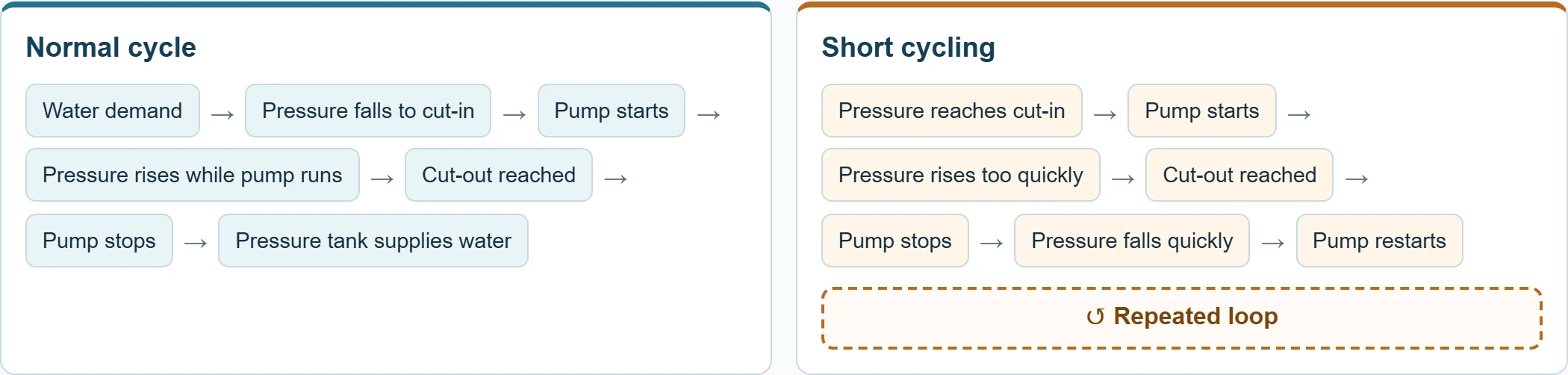
A conventional well pump is short cycling when it repeatedly starts, runs only briefly, shuts off, and starts again much sooner or more often than the system is designed for.
That's different from a pump simply turning on when you open a faucet — that's the system working correctly. What's worth investigating is a pattern like this: pressure falls, the pump starts, pressure rises, the pump shuts off almost immediately, pressure falls again right away, and the pump restarts — repeating every few seconds or every minute or so, either during steady water use or, more tellingly, when no fixtures are running at all. Cycling with everything off is one of the most useful clues you can gather, because it points away from ordinary demand and toward a tank, switch, or leak problem.
There's no single, universal stopwatch cutoff for what counts as "too short." Manufacturer sizing guidance gives a sense of scale rather than a diagnostic rule: Pentair's WellMate documentation states plainly that "WellMate recommends at least 1 minute run time" when sizing a conventional diaphragm tank, while Amtrol's own Well-X-Trol sizing worksheet calls for a longer minimum — at least 2 minutes — when the example pump is large (its worked example uses a 15 HP, 85 GPM submersible pump).
In other words, the "right" run time scales with your pump and tank, not with a single number that applies to every system. A repeated, very short on/off pattern is more useful diagnostically than comparing your pump against any one cutoff.
Conventional vs. constant-pressure systems
Before you look at the pressure tank, figure out which kind of system you actually have — because the rest of this guide's diagnostic logic depends on it.
A conventional system uses a mechanical pressure switch and a pressure tank sized to give the pump a real run time between starts, with a clear cut-in pressure (where the pump turns on) and cut-out pressure (where it turns off). This is what most of this article addresses.
A variable-speed or constant-pressure system — Franklin Electric's SubDrive line is one common example — uses an electronic controller and a pressure sensor to continuously adjust the pump's motor speed to match demand, rather than switching the pump fully on and off at two fixed pressures. These systems often pair with a noticeably smaller pressure tank than a conventional setup uses. A small tank on one of these systems, or the motor's speed changing frequently, is not automatically evidence of a problem — it can simply be the system doing what it was designed to do.
If you have this kind of controller and you're not sure whether its behavior is normal, the fastest path is your controller's manual, the manufacturer's support line, or a well professional familiar with your specific equipment — not the conventional pressure-switch diagnosis below. The dedicated constant-pressure section below explains this in more detail.
| What you observe | Likely area to investigate | Why | Next safe step |
|---|---|---|---|
| Very short, repeated pump runs while water is being used | Pressure tank (air charge or precharge) | A tank storing little usable water forces the pump to restart almost immediately after any draw | Confirm whether cycling also happens with everything off (see next row), then check the tank |
| Cycling continues even when every fixture is off | Leak, check valve, or pressure switch | With no demand on the system, repeated cycling points away from normal use and toward something bleeding pressure or a switch misreading it | Check for a running toilet or irrigation zone first — it's the fastest thing to rule out |
| Pressure rises from cut-in to cut-out almost instantly after the pump starts | Pressure tank (little usable drawdown) | A tank with very little air cushion fills to cut-out pressure almost as soon as the pump starts | Check the tank's air charge with the pump off and the system depressurized |
| Pressure falls rapidly right after the pump shuts off, with no water running | Leak-back — a leak or a check valve | Water is escaping somewhere in the system (or draining back toward the well) faster than it should | Watch the gauge over a few minutes with everything off; note the pattern rather than trying to fix it yourself |
| Rapid clicking or chattering from the pressure switch | Pressure switch or its sensing line | A switch reading pressure incorrectly, or a clogged sensing line, can make the pump cycle far more than the tank alone would explain | Note the behavior; a full switch diagnosis is outside this guide's scope |
| A relatively small tank paired with an electronic constant-pressure controller | Possibly nothing — check your system type first | Constant-pressure systems are commonly designed around smaller tanks than conventional systems use | Check the controller manual or manufacturer support before assuming the tank is undersized |
This table is meant to route your next step, not to hand you a diagnosis — several causes can produce a similar symptom.
Why the Pressure Tank Is Often the First Place to Look
The pressure tank is usually the first thing worth checking, but it isn't automatically the answer. NGWA's WellOwner resource lists a malfunctioning pressure tank and a faulty pressure switch among the common, recognized explanations for frequent pump cycling, and Amtrol identifies rapid cycling as a symptom associated with pressure-tank problems in its own tank support documentation. That's a reasonable starting point — not a rule that says every case of short cycling traces back to the tank.
Waterlogged tank / lost air charge
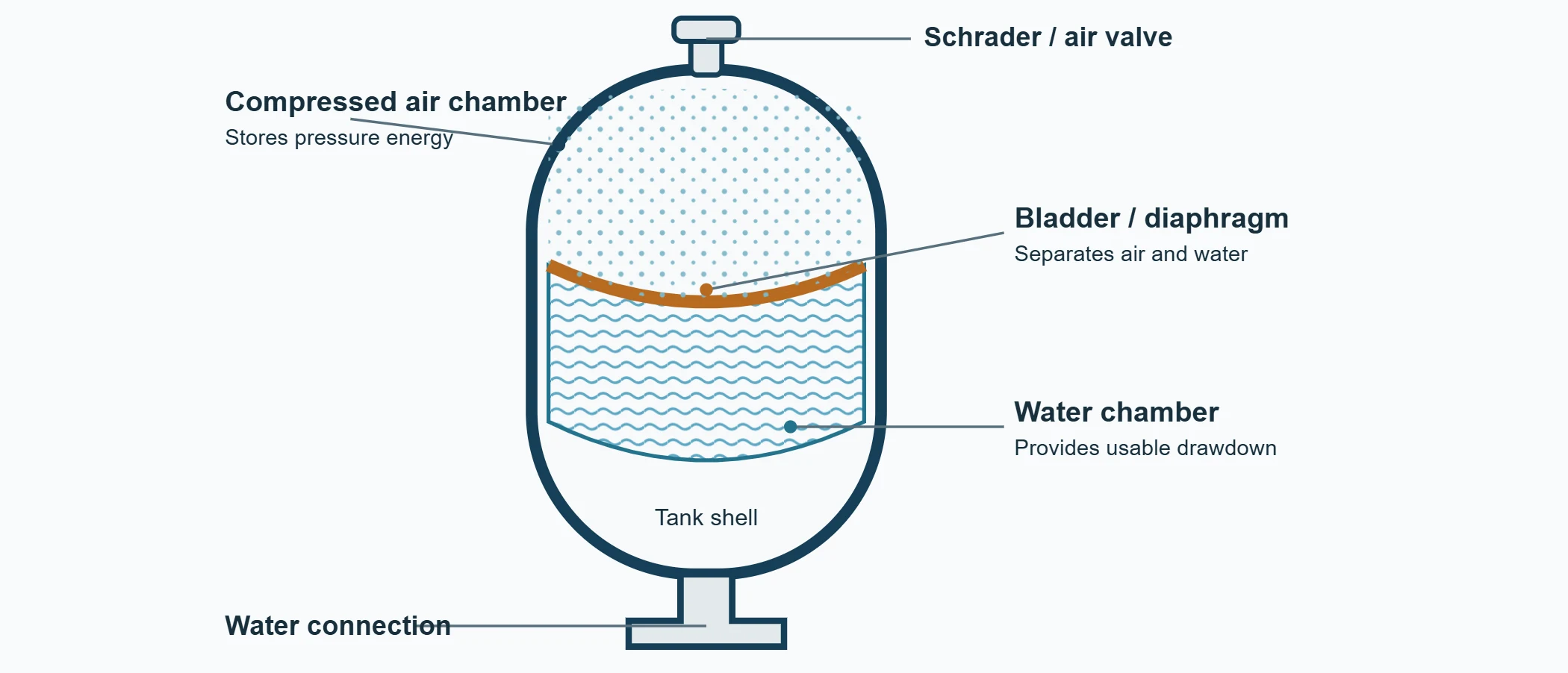
A pressure tank uses a compressed air cushion to store energy and supply water between pump cycles. In a modern precharged bladder or diaphragm tank, that air is separated from the water by the internal bladder or diaphragm. That air cushion is what lets the tank supply some water on its own, without the pump running, between cycles. If that usable air volume is lost — whether from a slow leak or a torn bladder — the tank can no longer store much pressurized water at all. The result is exactly what it sounds like: the pump has to restart almost as soon as it stops, because there's nothing left in the tank to draw from.
Failed bladder or diaphragm
Most modern precharged residential tanks separate air from water with an internal bladder or diaphragm. When that bladder or diaphragm fails, the tank effectively becomes "waterlogged" — clues include rapid cycling, very little usable drawdown, pressure that swings quickly, and — specifically on bladder/diaphragm-style tanks — water (rather than air) coming out of the Schrader (tire-style) air valve on top of the tank.
That last test applies to precharged bladder/diaphragm tanks specifically; older, non-bladder tank designs don't behave the same way, so don't assume every tank on a property uses this same internal construction. On an appropriate bladder/diaphragm tank, water at the air valve is a strong indication of internal failure and typically means the tank needs service or replacement.
Incorrect pressure-tank precharge
If the bladder is intact, a low air charge can produce the same rapid-cycling pattern. Checking it is straightforward: turn off power to the pump, open a faucet or drain valve to relieve the water-side pressure down to 0 PSI, and only then check the air pressure at the tank's valve with a standard tire gauge. A reading taken while the tank still holds water pressure isn't meaningful.
Amtrol's official guidance for its well tanks sets precharge at roughly 2 PSI below the pressure switch's cut-in setting — manufacturer-specific guidance for conventional precharged bladder/diaphragm tanks, not a universal number. Check your own tank's documentation and your actual cut-in pressure before assuming a figure, and don't assume a 30/50 or 40/60 switch setting without confirming it.
If precharge is low, don't automatically add air to an in-service tank. Check the tank manufacturer's instructions and inspect for damage or corrosion first. Amtrol specifically warns against repressurizing a tank that has lost air or shown reduced cycle time unless tank integrity has been confirmed, because internal corrosion can create a rupture hazard — its own safety documentation states that only licensed professionals should check, adjust, or recharge precharge on tanks already in service. Treat a low-precharge reading as a strong diagnostic clue to bring to a professional, not as a green light to reach for a compressor.
Tank too small for the pump
A larger tank gives more usable "drawdown" — the amount of water it can release before the pump needs to restart — which directly translates into longer run times and fewer cycles. If your tank seems undersized for your pump's flow rate, RuralWaterHQ's pressure tank sizing calculator estimates an appropriate tank size from your pump's flow rate, your pressure switch's setting, and your target minimum run time, without you needing to work through the drawdown math by hand.
Other Causes Worth Checking
A running fixture or plumbing leak
Worth ruling out early since it's fast and tool-free: a running toilet fill valve, an irrigation zone left on, a dripping fixture, or a visible leak can all pull enough water to force repeated cycling. If cycling continues with every fixture off, a leak or leak-back becomes much more likely. If it stops, you've confirmed that water demand is triggering the cycling — but a pressure-tank problem can still be the reason the pump is starting and stopping too frequently during that demand.
Pressure switch or sensing problems
Chattering, rapid clicking, opening and closing far more than it should, visible corrosion, or an obstructed sensing line can all produce cycling that looks like a tank problem. This article stops at noting those symptoms — full diagnosis and replacement is the job of a dedicated pressure-switch guide. Don't attempt live electrical testing, contact cleaning while powered, or any bypass/jumper procedure.
If the clicking clusters around one pressure rather than a clean cut-in/cut-out cycle, or the behavior doesn't track normal water demand, the pressure switch or sensing path becomes one branch worth investigating — our pressure switch guide explains how to separate that possibility from tank and pump faults.
A leaking check valve
If pressure falls rapidly right after the pump shuts off with no fixtures running, water may be leaking back somewhere — a plumbing leak, a failing check valve, or an issue on the well side. Watching the gauge for this pattern is a safe observation; pulling a submersible pump or accessing a foot valve downhole is professional work.
A clogged sediment filter or restriction
If an accessible sediment filter is obviously overdue, checking or replacing it per its own instructions is a reasonable, low-risk step — but treat it as a secondary check, not a first assumption.
A low-yield well
A well that can't recharge as fast as the pump draws from it can cause pressure loss, pump-protection shutdowns, and irregular restarts — a different mechanism from classic tank short cycling, even though it can look similar. Worth mentioning to whoever you call in, but not this guide's focus.
Pump, controller, or electrical faults
Last branch, not the first. A failing control box, motor issue, or wiring fault can produce erratic cycling, but confirming any of them requires professional diagnosis. Don't treat pump replacement as a default answer before the causes above are ruled out.
A Safe, Step-by-Step Way to Diagnose It
- Identify your system type and confirm the pattern. Conventional switch-and-tank, or constant-pressure controller? Note what's happening, how often, and under what conditions.
- Turn off all water demand. Close every fixture and irrigation zone, then watch whether cycling continues with nothing running.
- Watch the pressure gauge. Note roughly where it cuts in and cuts out, and whether pressure climbs gradually or drops off quickly. Don't adjust the switch yet — you're gathering information.
- Evaluate the pressure tank (conventional systems) using the checks above, pump off and system depressurized first.
- Consider the pressure switch and sensing line as an observation, not a repair.
- Stop at well-side, check-valve, pump, or electrical causes and bring in a professional.
Why the Pressure Gauge Tells You So Much
The gauge does most of the diagnostic work, and it's worth reading carefully rather than glancing at once. Pressure shooting from cut-in to cut-out almost instantly suggests the tank is storing very little usable water — a lost air charge or tank problem becomes more likely, not certain. Pressure falling quickly after shutoff with nothing running points toward a leak or leak-back instead. Chattering around one pressure without a clean cut-in/cut-out pattern makes a switch or sensing issue more plausible. None of these are a definitive diagnosis on their own — they narrow down where to look next, measured against your own system's actual cut-in and cut-out numbers, not a universal PSI setting.
If You Have a Variable-Speed or Constant-Pressure System
A variable-speed or constant-pressure system — Franklin Electric's SubDrive line is a well-known example of this kind of architecture — uses an electronic controller and a pressure sensor to adjust the pump's motor speed continuously as demand changes, instead of switching the pump fully on and off between two fixed pressures the way a conventional system does. These systems are commonly paired with a smaller pressure tank than a conventional setup would use, because the tank isn't doing the same job.
That matters for diagnosis in two specific ways. First, a small tank on one of these systems is not, by itself, evidence that something is undersized — it may simply be how the system was designed. Second, the pump's motor speed changing frequently to track demand is not the same thing as conventional on/off short cycling, and the classic cut-in/cut-out diagnosis in this article doesn't map cleanly onto how these controllers work.
What's still worth paying attention to on a constant-pressure system: a controller fault or alarm light, the pump actually stopping and fully restarting repeatedly rather than smoothly modulating speed, genuinely unstable pressure at your fixtures, or behavior that clearly doesn't match what your system's documentation describes. If you see any of that, the right next step is your controller's manual, the manufacturer's support line, or a well professional who works with your specific equipment — not adjusting the controller's settings yourself.
Homeowner vs. Professional: Where the Line Is
Safe to observe yourself, anytime: listening to the cycling pattern, timing roughly how long the pump runs, watching the gauge, shutting off fixtures to test for leaks, identifying which type of system you have, and glancing at an accessible sediment filter.
Safe to check only with the pump's power off and the system fully depressurized: testing the tank's air valve and measuring precharge to see what's going on.
Professional territory, not a DIY project: pressure-switch replacement or any internal contact work, live electrical testing of any kind, control-box or motor diagnosis, check-valve replacement, pulling a submersible pump, any downhole or foot-valve work, diagnosing a suspected underground leak, a breaker that trips repeatedly, and adjusting or repressurizing precharge on a tank that's already in service.
That last one is worth calling out specifically: Amtrol's own safety documentation states that only licensed professionals should check, adjust, or recharge precharge on an in-service tank, because low air pressure or reduced pump run time can signal internal corrosion — and adding pressure to a corroded tank risks rupture. Don't jumper or bypass a pressure switch, don't probe live voltage, don't test a capacitor, and don't defeat any protective device to "see if that's the problem" — those are the situations where calling a well contractor or electrician is the actual fix, not a shortcut around one.
| Possible cause | Typical clue | Safe homeowner check | Typical next step | DIY / professional |
|---|---|---|---|---|
| Lost tank air charge | Rapid cycling, little drawdown | Air valve test with power off and system drained | Inspect for corrosion/damage; do not repressurize an in-service tank without confirming integrity first | Follow manufacturer guidance; professional recommended before repressurizing an in-service tank |
| Failed bladder/diaphragm | Water (not air) at the Schrader valve | Same air valve test | Tank service or replacement | DIY-feasible, often contracted out |
| Undersized tank | Short runs even with a healthy air charge | Compare tank size to pump flow using the sizing calculator | Replace with a correctly sized tank | Professional installation typical |
| Plumbing leak / running fixture | Cycling stops once everything is confirmed off | Walk-through of toilets, irrigation, visible leaks | Repair the specific fixture or leak | DIY for the fixture itself |
| Pressure switch / sensing issue | Chattering, rapid clicking, obvious corrosion | Visual/audible observation only | Full diagnosis and replacement | Professional |
| Check valve / leak-back | Pressure drops fast after shutoff, no water running | Watch the gauge over a few minutes | Locate and repair the leak source | Professional |
| Filter restriction | Reduced flow, overdue filter | Visual inspection of an accessible filter | Replace per its own instructions | DIY |
| Constant-pressure/VFD behavior | Small tank, frequent speed changes, no fault codes | Check controller manual/status lights | Confirm normal operation with manufacturer/professional if unsure | Professional for anything beyond observation |
Why Well Pump Short Cycling Matters
Frequent cycling isn't necessarily an emergency, but it's not nothing either. Each start puts more mechanical and electrical stress on the motor and switch than a normal run cycle does, and repeated starts over time can contribute to earlier wear on those components.
NGWA's WellOwner resource treats frequent cycling as a system issue worth professional evaluation rather than something to ignore, and pressure-tank manufacturers explicitly design their tanks around giving the pump longer run times specifically to reduce how often it cycles — that's the whole point of the drawdown-and-runtime sizing approach described above. None of that means a short-cycling pump is about to fail immediately; it means the issue is worth tracking down rather than living with indefinitely.
When to Call a Professional
Bring in a licensed well contractor, plumber, or electrician when: the pressure switch itself needs replacement or internal repair, you suspect a check valve or leak somewhere in the well-side plumbing, a breaker for the pump trips more than once, you're dealing with a constant-pressure/VFD system showing a fault code or behavior you can't explain from its own documentation, or you've worked through the safe checks above and the cause still isn't clear. None of this means your pump needs to be replaced — replacement is a conclusion to reach only after a professional has actually confirmed pump or motor damage, not a default response to cycling on its own.
FAQ
What causes a well pump to short cycle?
Most often a pressure tank that's lost its air charge or had its bladder fail, but a running fixture, a leaking check valve, a faulty pressure switch, or — on some systems — normal constant-pressure operation can all produce a similar pattern.
How do I know if my well pump is short cycling?
Watch for the pump starting, running briefly, stopping, and restarting again much sooner than expected — especially if it keeps happening with every fixture in the house turned off.
Is short cycling bad for a well pump?
It adds more starts and more stress to the motor and switch than normal operation does, which can contribute to earlier wear, but it's not automatically an emergency or a sign the pump itself is failing.
How long should a well pump run?
There's no single number that applies to every system — it depends on your pump's flow rate and your tank's size. Pentair's WellMate guidance calls for at least 1 minute of run time when sizing a conventional tank, while Amtrol's own sizing worksheet recommends a longer minimum for larger pumps; check your actual pump and tank documentation rather than comparing against one fixed figure.
How often should a well pump cycle?
A properly sized conventional system shouldn't repeatedly start and stop every few seconds under steady use, but the "right" frequency depends on your pump's flow, your tank's drawdown, and your household's demand — there's no universal starts-per-hour number that applies across every setup.
What are the symptoms of a bad pressure tank?
Rapid, repeated cycling; very little usable drawdown; and — on bladder/diaphragm tanks specifically — water instead of air coming from the Schrader valve when the system is depressurized.
Does a constant-pressure well system short cycle?
Not in the conventional sense. These systems adjust motor speed continuously rather than switching fully on and off, and they're commonly paired with smaller tanks by design — a small tank or frequent speed changes on this kind of system usually isn't a fault. If you're unsure, check your controller's documentation or contact the manufacturer.