
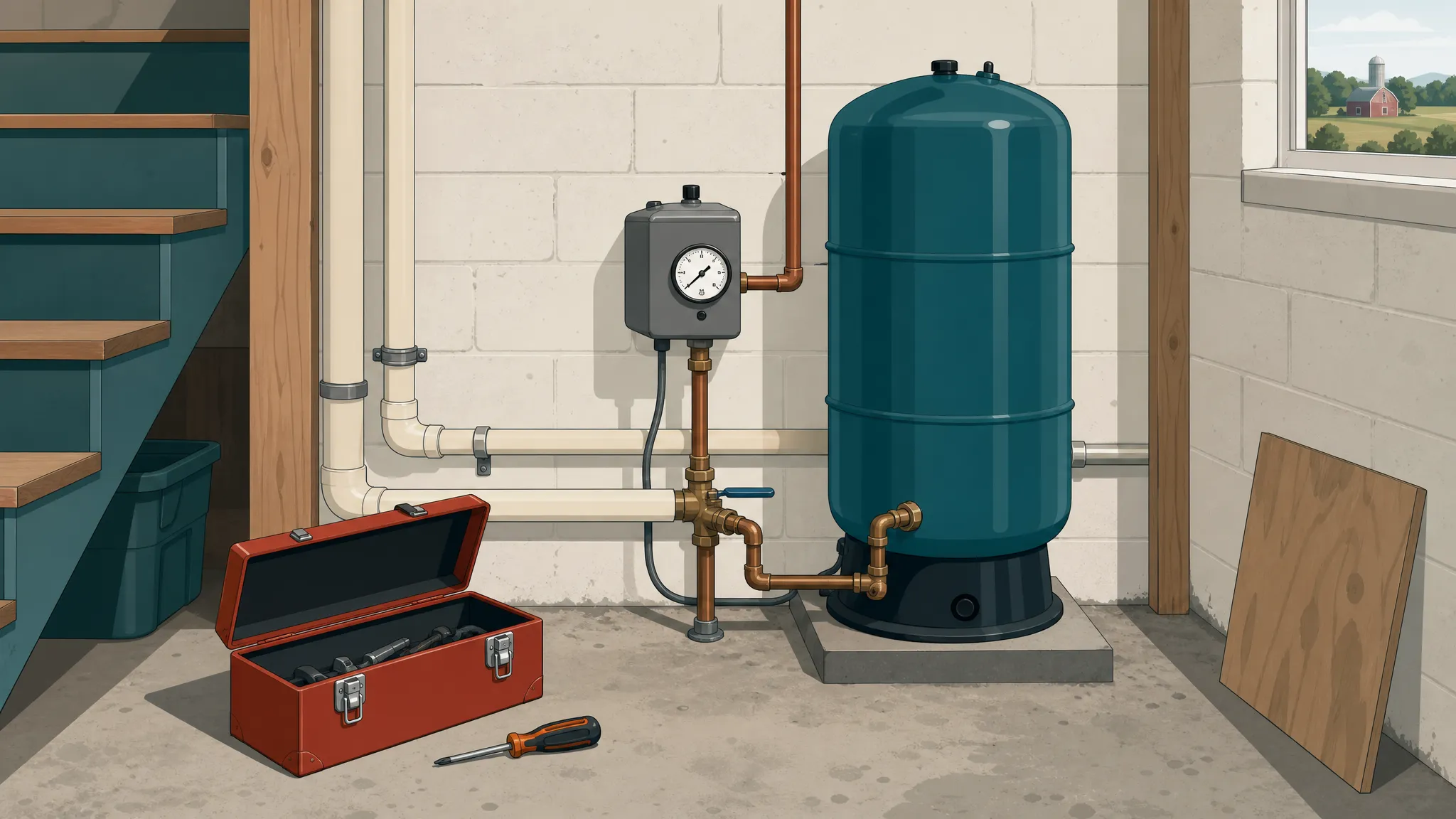
If your well pump is not working, start with pressure and power before you price a full replacement. A well pump that stops working follows one of a handful of failure patterns, and in a large share of cases, the fix is a $25–$60 part you can replace in an afternoon, not a $1,500 pump. This well pump troubleshooting guide walks the same diagnostic tree a well technician uses, in order of probability and cost, so you replace the part that’s actually broken.
Before anything else: check your breaker panel. A tripped 240V double-pole breaker labeled “well” or “pump” is the single most common cause of sudden no-water calls. Reset it once. If it trips again, stop! repeated tripping means an electrical fault, and that’s a pro visit, not a reset loop.
Step 1: Read your pressure gauge
Find the pressure gauge next to your pressure tank. It tells you which branch of the tree you’re in:
| Gauge reads | Meaning | Go to |
|---|---|---|
| 0 PSI, pump silent | Pump isn’t receiving or responding to power | Step 2 — power & switch |
| Below cut-in (e.g. under 30/40 PSI), pump silent | Pressure switch not closing | Step 2 — switch |
| Pressure normal but no water at taps | Blockage after the tank (filter, softener, valve) | Step 4 |
| Needle bouncing rapidly, pump clicking on/off | Short cycling — tank or switch | Step 3 |
| Pump runs nonstop, pressure never reaches cut-out | Leak, dry well, or worn pump | Step 5 |
Step 2: The pressure switch
The pressure switch is typically a small enclosed control mounted near the pressure tank/tank tee on conventional systems; Square D Pumptrol-style switches are a common example, though not the only one. It senses pressure in the pipe and switches the pump on at a cut-in pressure and off at a cut-out pressure. A switch that isn’t reading pressure correctly — often because a small nipple feeding it has silted up — can prevent the pump from starting even when everything else in the system is fine.
From the outside, with the cover on, check for corrosion, rust staining, water at the switch or its connections, and damaged conduit or tubing. If your switch has an external lever on its side, check whether it’s been latched off by a low-pressure event. If you see water getting into the switch, or the breaker trips when the pump tries to start, turn the pump off at the breaker and call a professional.
Don’t remove the cover. The terminals inside carry line voltage, and the switch manufacturer’s own instructions call for disconnecting all power before servicing and securing the cover before restoring it. Everything inside the switch — the contacts, the settings, the sensing nipple, and replacement — is work for a licensed professional.
→ Well pump pressure switch problems: symptoms and what to check safely walks through how to tell whether the switch is likely the cause, and how to separate a switch fault from a pressure-tank fault.
Step 3: Short cycling, it’s almost never the pump
For replacement planning, use the pressure tank sizing calculator to estimate tank drawdown needs.
If the pump snaps on and off every few seconds while water runs, your pressure tank has almost certainly lost its air charge (a “waterlogged” tank). Confirm it: kill the pump breaker, drain the system from a low faucet, and press the Schrader valve on top of the tank. If water comes out of the air valve, the bladder is ruptured, the tank is done. If air comes out, check the pre-charge with a tire gauge: it should read 2 PSI below your cut-in pressure (e.g., 38 PSI for a 40/60 switch). Recharge with a compressor if low.
A ruptured tank means replacement, $200–$600 for quality models depending on size, and arguably the most worthwhile DIY job in the whole system, because short cycling destroys pumps. For broader system basics, see our well pumps and pressure systems guide.
Step 4: Pressure is fine, but no water flows
If the gauge shows normal pressure, the well side is healthy and the blockage is downstream. If the symptom is color, odor, stains, or taste rather than flow, use our well water problems guide instead. Check in order: a sediment filter overdue for a cartridge change (the #1 culprit), a softener stuck in bypass or regeneration, a partially closed valve after recent work, and in winter, a frozen line section.
Step 5: Pump runs constantly
A pump that never reaches cut-out pressure is either pushing water out of a leak, pulling from a well that’s temporarily dry, or genuinely worn out. Walk the line from tank to wellhead looking for wet ground. Listen at the wellhead: sputtering or air spitting at taps suggests low water level common in drought or after heavy irrigation; give the well several hours of rest and retest. If the well has water and there’s no leak, a submersible that can no longer build pressure after 10–15 years of service is at end of life.
Well pump repair costs: repair or replace?
Some no-water problems come from relatively inexpensive components, like the pressure switch, rather than the pump itself — so work through the diagnostic steps above before assuming the pump needs to be replaced.
If a professional confirms that the pump or motor itself has actually failed, a standard residential replacement commonly falls around $900–$3,000 installed, with deeper or more complex systems costing more. For current costs by pump type, what’s included in an installed quote, and the factors that raise the price, see our Well Pump Replacement Cost Guide.
When to stop and call a pro
Before you call a licensed well contractor, you can also use the free well and septic tools to narrow the likely failure. Call a licensed well contractor when: the breaker trips repeatedly (electrical fault), the pump is submersible in a well deeper than ~100 feet (pulling it requires equipment and experience), you find damaged wiring, or the well itself may be failing (chronic sputtering, sediment surges). Everything upstream of those lines – switch, tank, filters, gauges – is legitimate homeowner territory.
FAQ
How do I know if it’s the well pump or the pressure switch?
If system pressure is below the expected cut-in and the pump doesn’t start, the issue may be in the switch or its sensing path, a low-pressure cut-off, the power supply, or the pump/control equipment. Hearing a click from the switch narrows the pattern but doesn’t prove the switch is electrically healthy — confirming which component has actually failed requires professional electrical testing. Our pressure switch troubleshooting guide covers the observations you can safely make yourself.
How long do well pumps last?
Several current homeowner cost guides cite roughly 10–15 years as a broad service-life reference for residential well pumps, but this is not an expiration date. Service life varies with cycling frequency, water quality, sizing, usage patterns, well conditions, equipment quality, and pump type.
Why did my well pump stop after a power outage?
Check the breaker first, then look for a pressure switch with a low-pressure cut-off lever. A pressure drop during the outage can latch that protection off. Exact trip points and reset behavior are model-specific, so use the instructions for your switch or call a well professional if the cause is unclear.
Can I replace a well pressure switch myself?
We don’t publish a replacement procedure. A pressure switch sits on line voltage and on the pressurized side of the plumbing, and the manufacturer’s instructions warn that failing to disconnect power before servicing can result in serious injury. Replacement also means matching the switch to your pump, your tank pre-charge, and your system’s pressure rating. If diagnosis points to the switch, have a licensed well or pump professional replace it.