
Specifications, warranties and prices checked September 2026.
The best water softener for well water is the one whose documented limits sit above your water test results, not the one with the loudest marketing. If your water is hard and carries little or no iron, a properly sized metered softener is usually enough. If it also has dissolved (ferrous) iron, you need a softener with a stated iron rating that clears your number. Above that, or with red-water iron, a sulfur smell or iron bacteria, a softener alone is the wrong tool.
This guide starts with a test-first decision table, then covers four systems chosen from manufacturer manuals, warranties and certification listings.
Disclosure: RuralWaterHQ may earn a commission from qualifying purchases, at no extra cost to you. Only SoftPro links currently earn one. Recommendations follow the manufacturers’ own documents, not commission availability.
Do You Need a Special Water Softener for Well Water?
Short answer: Not always a different type of softener, but always a different buying process. A salt-based ion-exchange softener works the same way on well and city water. The difference is what reaches the resin: wells can carry iron, manganese, hydrogen sulfide, sediment and bacteria that municipal treatment normally removes. Test first. You may need pretreatment, a fine-mesh softener, or a different system entirely.
Our hard water guide for wells covers what grains per gallon mean and how salt-based softeners differ from salt-free conditioners. This page is about choosing a product.
Before You Buy: Test These Eight Things
A softener chosen without a test is a guess. Ask for these results, in these units:
- Hardness in grains per gallon (GPG). If hardness is reported as mg/L (or ppm) as CaCO3, divide by 17.1 to convert to grains per gallon.
- Dissolved (ferrous) iron in ppm. This is the form a softener’s resin can exchange.
- Total and visible (ferric) iron. Ferric iron is already solid and is the form that fouls resin.
- Manganese. Black staining is the clue.
- pH. Acidic water changes which system you need.
- Hydrogen sulfide. The rotten-egg smell.
- Sediment or turbidity.
- Bacteria. If you see slime or a musty odor, say so; a standard iron test does not detect iron bacteria.
Not sure how to read the report? See how to read your well water test results, and our well water testing guide if you still need a lab.
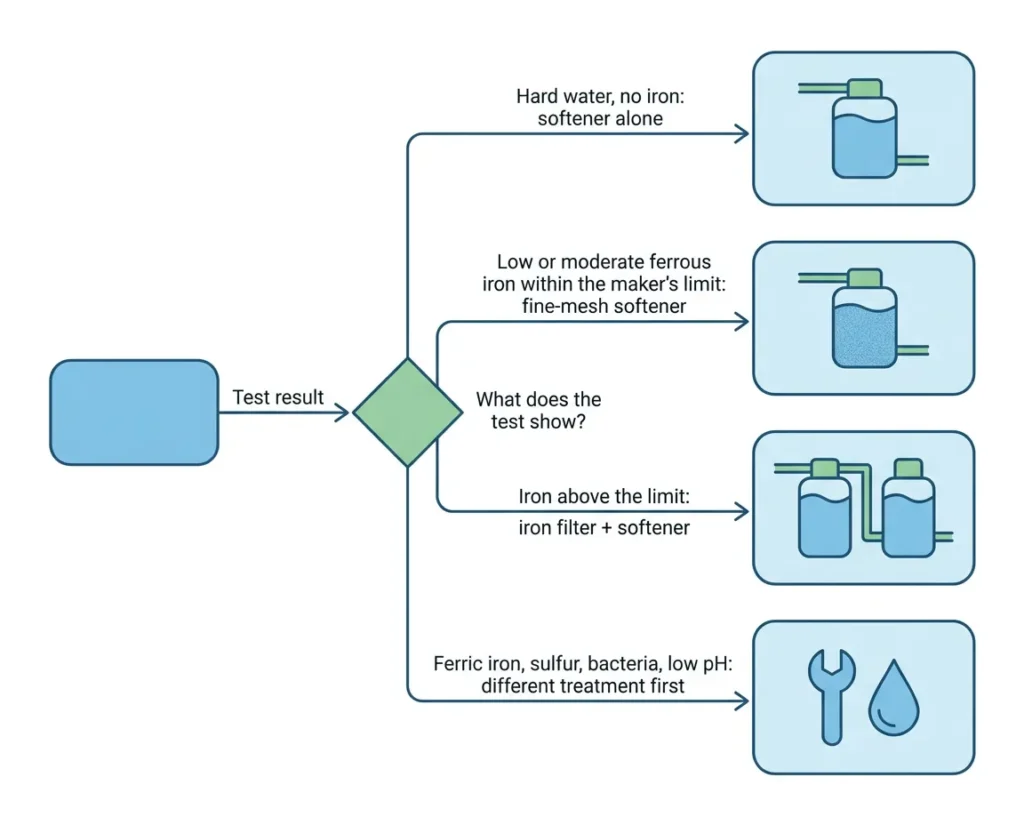
Iron-First Decision Table
Find your row before you look at any product. The right-hand column is the one most buying guides skip.
| Your test shows | What that means | What to buy | Where a softener is the wrong tool |
|---|---|---|---|
| Hard water; iron below 0.3 mg/L or not detected | Hardness is the only problem to solve | Any properly sized metered softener. Iron ratings do not matter | Sulfur smell, sediment or bacteria are separate problems |
| Hard water + low ferrous (clear-water) iron | Resin removes some iron along with hardness, which uses up capacity and needs regular cleaning | A metered softener whose manufacturer states an iron limit above your number, with the manufacturer’s iron adjustment applied to the hardness setting | If the maker publishes no iron limit, treat the rating as unknown |
| Hard water + moderate ferrous iron | Near or above what ordinary resin tolerates. Published limits run from 1 ppm to 10 ppm | A fine-mesh softener with a published ferrous limit and margin above your number, or an iron filter ahead of a standard softener | Little margin between your result and the stated limit |
| High iron, above the stated limit for the exact model | Resin will foul and the warranty may not cover it | Iron filter first, then a softener. See our iron filter for well water guide | Softener alone |
| Orange or red water at the tap (ferric iron) | Iron is already solid; ion exchange does not strain it out | Filtration or an oxidizing iron filter | Any softener |
| Rotten-egg smell (hydrogen sulfide) | A dissolved gas, not a hardness mineral | An oxidizing or catalytic treatment stage ahead of the softener | Softener |
| Black staining or manganese on the test | Behaves like iron, but most softener documents give no manganese limit | Get the manufacturer’s manganese limit in writing, or use an oxidizing filter | Softener with no stated manganese rating |
| Slime, rainbow sheen, musty odor | Possible iron bacteria, a biological problem | Well disinfection or professional help | Softener |
| Cloudy or gritty water | Sediment passes through and can damage seals and resin | Sediment filter upstream | Softener alone |
| Low pH (acidic) | Softeners do not raise pH, and each has a stated pH range | A neutralizer ahead of the softener | Softener |
These rows are decision rules, not universal ppm cutoffs. Manufacturers disagree, as the iron limits section shows.
Best Water Softener for Well Water: Our Picks by Situation
These are situation-based picks, not a ranking. Each fits a different water profile. Specifications come from manuals and manufacturer pages, and we label anything that is a manufacturer claim. Only the SoftPro links in this article earn a commission.
- Whirlpool WHES40: best documented value pick
- AFWFilters Iron Pro 2: best single-tank option for moderate ferrous iron
- SoftPro Elite + Iron Master AIO: best complete system for hard water plus higher iron
- SpringWell SS1 / SS4 / SS+: best for hard well water with little or no iron
Whirlpool WHES40: Best Documented Value Pick
Fits: hard water with low-to-moderate clear-water iron and modest peak demand. Skip if: your iron is ferric, bacterial or colloidal, or you run many fixtures at once. Add a sediment filter first if your water is cloudy.
What Whirlpool’s owner’s manual says:
- Capacity: rated 17,300 grains at 3.4 lb of salt, 31,600 at 9.0 lb, and 40,000 at 15.5 lb. The 40,000 figure is the maximum, at the highest salt dose.
- Flow: 7.6 gpm rated service flow, with a 14.7 psi pressure drop at that flow. The manual also lists 11.4 gpm intermittent flow at 30 psi and says that is not the service-flow rating.
- Iron: 10 ppm maximum clear-water iron. A footnote says the capacity is substantiated by laboratory test data, and that Wisconsin requires additional treatment above 5 ppm. The manual says the unit will not remove ferric, bacterial, organically bound or colloidal iron, or sediment.
- Sizing rule: add 5 grains to the hardness setting for every 1 ppm of ferrous iron. Maximum supply hardness is 125 gpg.
- Efficiency: rated 5,094 grains per pound of salt at the minimum dose, using 3.0 gallons of regeneration water per 1,000 grains at that dose.
- Warranty: one-year full parts and labor, ten years on the tanks, three years on the electronic control board. The one-year full warranty can extend to five years if you use Whirlpool’s WHE-WSC cleanser every four months and keep proof of purchase.
- Certification (Verified): the NSF database lists Whirlpool WHES40 under NSF/ANSI 44 for hardness reduction and efficiency, filed under Water Channel Partners, the manufacturer named in the manual. The manual also states NSF/ANSI/CAN 372 and WQA certification, which we did not verify. The listing does not include an iron claim: Whirlpool’s 10 ppm figure comes from its own lab data.
- Price: varies by retailer and was not verified from Whirlpool’s site. Check before you buy.
Model naming: retailers commonly sell this as the WHES40E. We use “WHES40” for anything tied to the manual or the NSF listing, and we have not confirmed the two are identical. Ask the seller.
Drawback: 7.6 gpm rated service flow will be tight in a large household. The cleanser needed for the five-year warranty is an ongoing cost.
Install note: Whirlpool’s diagram for wells puts the softener after the pressure tank, with an optional sediment filter before it and the water heater after.
Verdict: the most fully documented softener in this guide, with a verified performance listing and a plainly stated iron limit. Best where hardness is the main problem and iron is modest and clear-water.
AFWFilters Iron Pro 2: Best Single-Tank Option for Moderate Ferrous Iron
Fits: hard water with ferrous iron up to 6 ppm, where you want one tank instead of two. Skip if: your iron is orange at the tap, or you need a third-party performance listing.
- Iron: AFW states fine mesh resin removes ferrous iron up to 6 ppm. It says fine mesh resin is not recommended for ferric iron and recommends a dedicated iron filter.
- Sizing rule: add 4 grains of compensated hardness for each ppm of iron and manganese.
- Hardware: Fleck 5600SXT digital metered valve on a Pentair tank, fine mesh resin, 1-inch male connections, bypass valve, and an 18 by 33 inch round brine tank with a safety float. The 80K listing also states 10% resin.
- Sizes: we verified the 64K and 80K listings.
- Flow: the 64K listing says it “treats up to” 16 GPM and the 80K listing says 18 GPM. AFW does not define these as service flow or peak flow, so we treat them as unlabelled.
- Warranty: five years on the control head and ten years on the tank, from AFW’s listing text.
- Certification: No listing found under “AFW” in the NSF/ANSI 44 database, and AFW claims none.
- Price (checked September 2026): $875 for the 64K, $949 for the 80K, both sale prices in AFW’s store.
Drawback: no third-party performance listing and no defined service flow. The warranty comes from listing text, not a manual we reviewed.
Install note: AFW includes installation instructions and lists phone and email support.
Verdict: AFW’s page is the clearest of the well-focused options about what the system cannot do: one iron form, one number, one caveat.
SoftPro Elite + Iron Master AIO: Best Complete System for Hard Water and Higher Iron
This award is for the pair, not for the Elite softener alone. SoftPro’s own installation guide draws the line: iron content must not exceed 1 ppm, and beyond 1 ppm an iron filter must be used. Its guide also puts any iron filter ahead of the softener. The Iron Master does that job, so the Elite only handles hardness.
Fits: hard water with dissolved iron above the Elite’s limit. If manganese or hydrogen sulfide is also present, the Iron Master may or may not be rated for your concentrations. SoftPro has not confirmed exact figures, so ask before you buy. Skip if: your water is hard with no iron problem (the pair is more system than you need), or you want a performance certification.
- Iron Master: manufacturer-stated for iron up to 30 ppm. It is an air-injection oxidation filter using Katalox media, which SoftPro’s spec page says lasts about 5 to 10 years, and as little as 3 to 5 in some water. SoftPro also markets it for manganese and hydrogen sulfide. Ask for the exact ppm ratings.
- Elite iron limit, two documents: the installation guide says 1 ppm. SoftPro’s warranty page separately lists clear-water iron up to 2.0 ppm. Because SoftPro’s own documents differ, plan around the lower figure unless SoftPro confirms otherwise in writing. The guide also calls for resin cleaning once iron passes 0.3 ppm.
- Flow (peak only): SoftPro publishes maximum peak flow, not service flow. For the Elite softener alone: 11 GPM (32,000 grain), 14 (40,000), 17 (48,000) and 20 (64,000). For the Iron Master, 6, 9 or 12 GPM depending on tank size, which SoftPro matches to well pump output. SoftPro’s guide says your well pump must at least equal the model’s required backwash flow rate.
- Warranty: SoftPro’s policy page lists lifetime on the tanks and control valve and seven years on electronics. On well systems, SoftPro treats the piston, seals and spacers as maintenance parts. Its guide recommends annual valve inspection. Resin warranty is listed only for city-water systems.
- Returns: six months, no restocking fee, but you return the complete system clean and drained and pay return shipping.
- Certification: No listing found under “SoftPro” or “Quality Water Treatment” in the NSF/ANSI 44 database. The product page shows NSF, WQA, ANSI, IAPMO and ISO logos without naming a standard or model, so we cannot say what they cover. WQA and IAPMO databases were not searched.
- Price (checked September 2026): Elite from $1,327 (32,000 grain, softener only). Iron Master from $1,517. Package pricing varies by size.
Documents that disagree: SoftPro’s installation guide and spec sheet list the well-water Elite as downflow, while its product page uses upflow language. The spec sheet lists fine mesh resin and the product page mentions 10% crosslink. Both could describe one resin, but SoftPro has not documented them together for this model. Ask before you order.
Drawback: the inconsistent documentation, plus a combined system costing well over either component.
Verdict: the logical setup when a test shows iron above the softener limits. Treat any iron claim for the Elite alone as unconfirmed.
SpringWell SS1 / SS4 / SS+: Best for Hard Well Water With Little or No Iron
Fits: hard well water where the test shows little or no iron, no sulfur and no manganese. Confirm first if: your test shows iron, manganese or sulfur. Don’t choose the SS alone without first confirming pretreatment requirements with SpringWell.
- Capacity and service flow: SS1, 32,000 grain, 11 GPM service. SS4, 48,000 grain, 13 GPM service. SS+, 80,000 grain, 20 GPM service. Backwash rates are 2, 2.4 and 4 GPM. Listed pH range is 6.5 to 10.
- Iron: SpringWell publishes no iron ppm limit for the SS. Its installation manual cautions against installing the SS on well water before speaking to customer service.
- Warranty conditions: for private wells, SpringWell’s terms require no hydrogen sulfide, no oils and copper of 1.30 mg/L or less. They say iron and manganese oxidize the media and pretreatment is highly recommended. Installing beyond the stated specification voids the warranty.
- Warranty terms: lifetime on covered items, but the same page lists five years on electronic heads. Ask which applies.
- Returns: six months for uninstalled units only, with a 10% restocking fee. Installed systems get a performance promise, not a refund.
- The iron products: the WS filter is SpringWell’s iron, sulfur and manganese product. It is manufacturer-stated for iron up to 7 ppm, hydrogen sulfide up to 8 ppm and manganese up to 1 ppm. The WSSS combines the WS filter with the SS softener; SpringWell’s page listed it from $3,123.75.
- Certification: No listing found under “Springwell” in the NSF/ANSI 44 database. SpringWell’s SS page and manual name no certification.
- Price (checked September 2026): not shown on SpringWell’s SS page. Google Shopping listed the SS1 around $1,607.
Drawback: SpringWell’s own documents leave the iron question open and send well-water buyers to customer service first.
Verdict: a well-documented hardness-only softener with published service flow at every size. It is the right choice only when your test is clean apart from hardness.
Also Considered: Aquasure Harmony Fine Mesh (AS-HS48FM)
Aquasure states its fine mesh resin is designed for up to 10 ppm of iron, against 2 ppm for its standard resin. The page reviewed does not say which iron form that covers. It lists $699.99, a downflow design and a digital metered head. The warranty is one year, extendable to five if registered within 60 days. Aquasure says only the tank carries NSF 61, and the complete system is not established as NSF/ANSI 44 certified. We could not confirm service flow, backwash flow or resin crosslink, so we have not awarded it. If Aquasure publishes a full spec sheet, it may earn a place.
We left out systems for which we could not confirm iron limits and flow from primary documents.
Comparison Tables
Fit, flow and iron
| Product | Best for | Capacity | Flow metric, as published | Iron limit and condition | Iron types excluded |
|---|---|---|---|---|---|
| Whirlpool WHES40 | Value; low-to-moderate clear-water iron | 40,000 grains maximum (17,300 / 31,600 / 40,000 at 3.4 / 9.0 / 15.5 lb salt) | 7.6 gpm rated service flow | 10 ppm clear-water iron (manufacturer; lab-substantiated); extra treatment above 5 ppm in Wisconsin | Ferric, bacterial, organically bound, colloidal |
| AFWFilters Iron Pro 2 | Moderate ferrous iron, one tank | 64K, 80K | “Treats up to” 16 GPM (64K) and 18 GPM (80K); not defined as service or peak | Ferrous up to 6 ppm (manufacturer) | Ferric (not recommended) |
| SoftPro Elite + Iron Master | Hard water plus iron above 1 ppm | Elite 32K to 64K; Iron Master 1.0, 1.5 or 2.0 cu ft media | Peak only: Elite 11 to 20 GPM by size; Iron Master 6, 9 or 12 GPM | Elite 1 ppm (install guide) or 2.0 ppm (warranty page); Iron Master iron up to 30 ppm (manufacturer-stated) | Elite alone: iron above its limit; hydrogen sulfide listed as none under rated conditions |
| SpringWell SS | Little or no iron | 32K, 48K, 80K | Service flow 11, 13, 20 GPM | None published | Iron, manganese and sulfur need pretreatment per warranty terms |
| Aquasure AS-HS48FM (also considered) | Budget option | 48,000 | Not stated | Up to 10 ppm iron; form not specified | Not stated |
Resin, warranty, certification and price
| Product | Resin | Warranty | Certification status | Price, checked Sep 2026 |
|---|---|---|---|---|
| Whirlpool WHES40 | High-capacity ion exchange resin, 1.14 cu ft; crosslink not stated | 1 yr full (up to 5 with cleanser); 10 yr tanks; 3 yr electronics | Verified: NSF/ANSI 44, WHES40 | Not verified |
| AFWFilters Iron Pro 2 | Fine mesh (80K listing also states 10%) | Head 5 yr; tank 10 yr (listing) | No listing found | $875 (64K); $949 (80K) |
| SoftPro Elite + Iron Master | Elite: fine mesh on spec sheet; Iron Master: Katalox media | Tanks and valve lifetime; electronics 7 yr; well seals are maintenance parts | No listing found; logos only | Elite from $1,327; Iron Master from $1,517 |
| SpringWell SS | Not specified in documents reviewed | Lifetime covered items; 5 yr electronic heads; conditions apply | No listing found | Not shown; about $1,607 on Google Shopping |
| Aquasure AS-HS48FM | Fine mesh; crosslink not stated | 1 yr; 5 yr if registered in 60 days | Manufacturer-stated NSF 61, tank only | $699.99 |
What Iron Can a Water Softener Actually Handle?
Short answer: Sometimes, but only dissolved (ferrous, clear-water) iron, and only up to the limit the manufacturer states for that exact model. In the documents reviewed, those limits range from 1 ppm to 10 ppm. Red-water (ferric) iron, iron bacteria and colloidal iron are not removed by ion exchange and can foul the resin.
The iron forms matter more than the brand. Our guide to how to tell which kind of iron you have covers diagnosis. In short: ferrous iron is dissolved and clear at the tap. Ferric iron is already solid and orange. Manganese and hydrogen sulfide are separate problems that a softener’s iron rating does not cover.
What manufacturers actually state:
| Source | Stated limit | Condition |
|---|---|---|
| SoftPro Elite installation guide | 1 ppm iron | Iron filter required beyond; resin cleaning above 0.3 ppm |
| SoftPro warranty page | 2.0 ppm clear-water iron | A separate, current policy document |
| AFWFilters Iron Pro 2 | 6 ppm | Ferrous only; ferric not recommended |
| Whirlpool WHES40 | 10 ppm | Clear-water iron; lab-substantiated; Wisconsin needs extra treatment above 5 ppm |
| Aquasure fine mesh | 10 ppm (manufacturer-stated) | Iron form not specified on the page reviewed |
| SpringWell SS | No ppm published | Warranty recommends pretreatment for iron and manganese |
The documents do not say how each number was set, and only Whirlpool says its figure is lab-substantiated. That gap is the reason to test first and pick a model whose written limit clears your result with room to spare. If iron is above the limit, an iron filter for well water goes ahead of the softener.
How to Size a Water Softener for Well Water?
Short answer: Multiply household size by about 75 gallons a day and by your hardness in grains per gallon, after adding the manufacturer’s iron adjustment to the hardness number. That gives daily grains. Choose a capacity that regenerates every several days, then check that the service flow and backwash needs fit your well pump.
Step 1: get compensated hardness. Iron uses up capacity, and makers use different rules:
- Whirlpool: add 5 grains per ppm of ferrous iron.
- AFWFilters: add 4 grains per ppm of iron and manganese.
- SoftPro’s guide: add 3 GPG when using the softener for iron of 2 to 3 ppm without an iron filter, which sits awkwardly beside its own 1 ppm limit.
Use the rule for the exact model you buy.
Step 2: estimate daily and weekly demand. SoftPro’s sizing guidance uses 75 gallons per person per day. Whirlpool’s manual example: 20 gpg hardness and 2 ppm iron becomes a setting of 30. Take a household of four. With iron, that is 4 × 75 × 30 = 9,000 grains a day. Whirlpool’s 40,000-grain rating (at its highest salt dose) would last about 4.4 days. Without iron, at 20 gpg, it is 6,000 grains a day, about 6.7 days. This is arithmetic, not a sizing verdict. SoftPro’s manual also recommends regenerating iron-affected softeners at 50 to 75% of calculated capacity.
Our water softener sizing calculator gives a starting estimate. Check its iron adjustment against your manufacturer’s rule.
Step 3: check flow. Three different numbers get confused:
- Service flow: the flow at which the maker rated capacity and pressure drop. Whirlpool and SpringWell publish it. Whirlpool says running above it can affect capacity and efficiency.
- Peak flow: a maximum, not a rating point. SoftPro publishes this.
- Backwash flow: what your well pump must supply during regeneration. SpringWell lists 2 to 4 GPM depending on model, and SoftPro says the pump must at least match its model’s requirement.
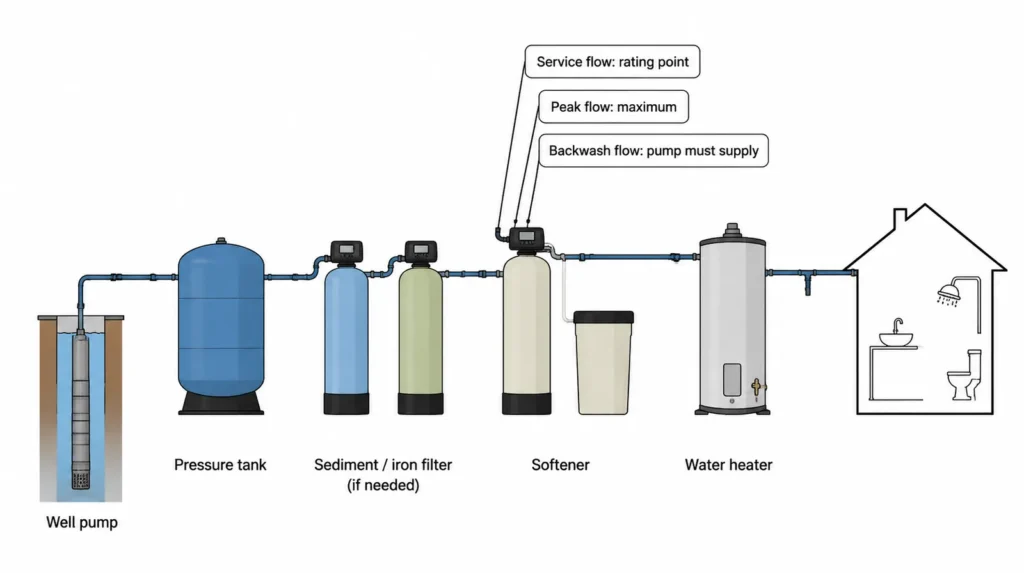
On a conventional pressure-tank system, estimate pump output with the drawdown and cycle-time method. Let the tank fill until the pump stops. Draw water and measure the gallons released until the pump switches on. Close the outlet, then time the pump from cut-in until it reaches cut-out and stops. Pumping rate (gpm) = drawdown gallons ÷ refill seconds × 60. A simple faucet bucket test measures the flow delivered at that outlet, not necessarily the pump’s capacity. Constant-pressure systems do not cycle this way and need a different method, so check the controller documentation or ask your well contractor. Either way, the pump must at least meet the treatment system’s required backwash flow. Install the softener after the pressure tank. Our well pumps and pressure guide explains what a pump can deliver.
When a Softener Is the Wrong Tool?
Rotten-egg smell: hydrogen sulfide needs a different treatment stage. SoftPro’s warranty lists hydrogen sulfide as none, and SpringWell requires its absence. See rotten egg smell in well water.
Orange water or slime: ferric iron and iron bacteria are not ion-exchange jobs. Whirlpool’s and SoftPro’s manuals both say so.
Cloudy water: a sediment filter goes upstream. Whirlpool’s manual says an upstream sediment filter normally corrects it, and SoftPro’s warranty notes sediment wears seals.
Low pH: a softener does not raise pH. Add a neutralizer.
Bacteria and nitrate: ion-exchange softening targets calcium and magnesium. Bacterial contamination and nitrate need their own treatment. Whirlpool’s and SoftPro’s manuals both warn against using a softener on microbiologically unsafe water without disinfection.
Buying Criteria That Matter on a Well?
Metered (demand) regeneration. Whirlpool documents demand-initiated regeneration and AFW lists a digital metered valve. Confirm the same for any other model you buy. Regenerating on use, not on a clock, saves salt when demand varies.
Fine mesh vs standard resin. Aquasure lists 2 ppm for standard and 10 ppm for fine mesh. Only trust a crosslink percentage if the maker states it for your model.
Service flow and backwash. Match both to your household and pump. Do not compare a peak figure with a service figure.
Pre-filtration. A sediment filter protects resin and valves.
What a certification covers. Claims inside an NSF/ANSI 44 listing matter individually. HR (hardness reduction) means the published hardness-reduction capacity is verified. ER (efficiency rating) means at least 3,350 grains of hardness removed per pound of salt and no more than 5 gallons of regeneration water per 1,000 grains removed. An NSF/ANSI 44 listing does not automatically verify iron-removal performance, and Whirlpool’s 10 ppm iron figure comes from its own lab data. A logo without a named standard and model is not evidence.
Warranty fine print. SpringWell voids coverage outside its specification. Whirlpool’s extension needs cleanser. Aquasure’s needs registration. SoftPro treats seals as maintenance on wells.
DIY or plumber. SoftPro’s guide estimates three hours for a handyman and four for a DIY install. Well pipework and drains make it harder than a city install.
Cost of Ownership
Expect ongoing costs beyond the sticker price:
- Salt and regeneration water. Whirlpool’s rated efficiency shows 3.0 gallons of regeneration water per 1,000 grains at minimum salt dose. Iron and hard water make regeneration more frequent.
- Resin cleaner. Whirlpool recommends its cleanser every four months, and SoftPro’s guide calls for cleaning every six months once iron is present.
- Replacement parts. SoftPro suggests an annual valve maintenance kit. Katalox media has a stated life of 5 to 10 years, sometimes 3 to 5.
- Installation. DIY saves labor but not the drain and plumbing work.
- Pretreatment. An iron filter can cost as much as the softener. SoftPro’s Iron Master starts at $1,517, and SpringWell’s combination starts at $3,123.75.
We have not given annual dollar totals because none of these makers publishes verified operating costs.
How We Chose These Systems?
Selection is based on manufacturer manuals and specification pages, warranty documents, published flow figures, water-quality limitations, current prices and fit for common private-well conditions. We searched NSF’s NSF/ANSI 44 listing by company name for Whirlpool’s manufacturer, SoftPro, Quality Water Treatment, SpringWell, Aquasure and AFW. “No listing found” means only that no listing appeared under that name, and a product can be filed under a different manufacturer. It does not mean a product is uncertified.
We label claims Verified (a database or document confirms it), Manufacturer-stated (the maker says so, unconfirmed), Not independently verified or No listing found. We did not use SoftPro-owned review or comparison pages as evidence, and SoftPro is currently the only brand here with which we have an affiliate arrangement. It won one award, and only for a two-part system its own manual supports.
Frequently Asked Questions
Do you need a special water softener for well water?
Not a different type, but a different process. Test for iron, manganese, sulfur, sediment and bacteria first, because wells can have all of them. See the special-softener answer above.
Can a water softener remove iron from well water?
Only dissolved ferrous iron, up to the stated limit for that model (1 to 10 ppm in the documents reviewed). Ferric iron, iron bacteria and colloidal iron are not removed. Details are in the iron limits section.
What is the best water softener for very hard well water?
There is no single best. Very hard water is mainly a capacity question. Whirlpool’s WHES40 lists a 125 gpg maximum, and AFWFilters and SoftPro list 80,000-grain sizes. Size on compensated hardness and household use, check flow, and pretreat if iron is over the limit.
What type of resin is best for well water?
For iron, the resins makers pair with published iron ratings are fine mesh (AFW, Aquasure). Confirm the ppm figure and its iron form. Fine mesh does not cure ferric iron.
Do I need an iron filter before a water softener?
Yes when iron exceeds the model’s stated limit, is ferric, or comes with manganese or sulfur. SoftPro’s guide says to use an iron filter beyond 1 ppm and to install filters before the softener. See our iron filter guide.
Can a water softener remove sulfur smell?
No. Hydrogen sulfide needs oxidizing or catalytic treatment. See rotten egg smell in well water.
How do I size a softener for well water?
Multiply household size by about 75 gallons and by compensated hardness, choose a capacity that regenerates every several days, then confirm flow and backwash against your pump. See the sizing section.
Bottom Line
The best water softener for well water is the one whose written limits clear your test results, not the one with the strongest sales page. For hardness and low clear-water iron, Whirlpool’s WHES40 is the most fully documented. For moderate ferrous iron in one tank, AFWFilters’ Iron Pro 2 states its limits plainly. For hardness with higher iron, sulfur or manganese, an iron filter plus softener is the logical build, and SoftPro’s Elite with the Iron Master is one option, once SoftPro confirms its manganese and sulfur limits. If your water is hard with no iron, SpringWell’s SS is a documented hardness-only choice, after you call customer service.
If your test shows dissolved iron above the softener’s limit and an iron-filter-plus-softener setup fits your water chemistry, SoftPro Elite + Iron Master is one system to compare.
Sources
- Whirlpool WHES40/WHES44 owner’s manual
- NSF/ANSI 44 listing, Water Channel Partners
- AFWFilters Iron Pro 2 (64K)
- SoftPro Elite installation guide
- SoftPro warranty and returns
- SoftPro product specifications
- SpringWell salt-based softener page
- SpringWell SS1/SS4/SS+ installation instructions
- Aquasure Harmony AS-HS48FM and Aquasure warranty