
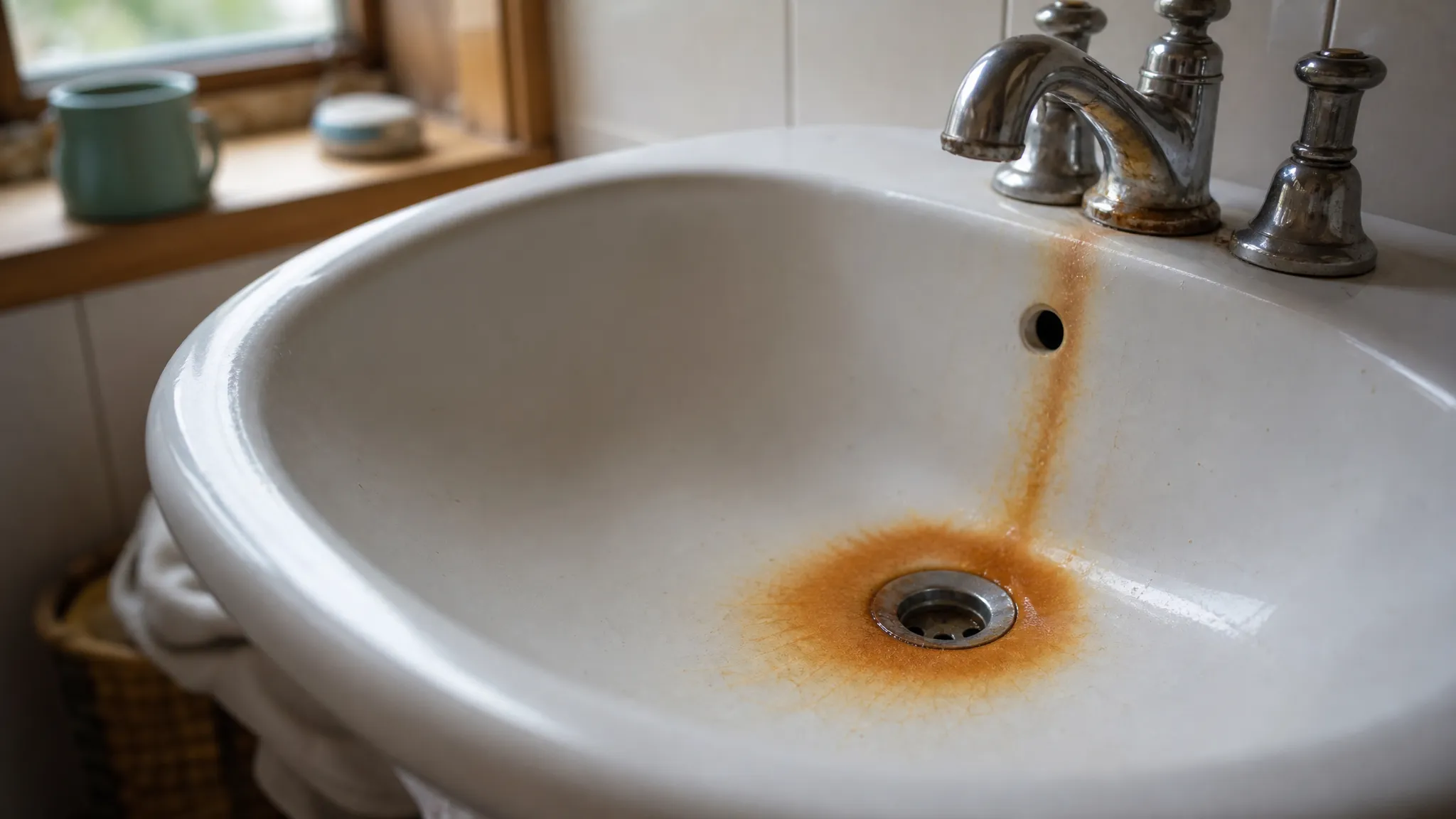
Iron in well water usually comes from groundwater moving through iron-bearing soil and rock, sometimes from corroding pipes or fixtures instead. The classic sign is orange, brown, or rust-colored staining on sinks, tubs, or laundry, but the same stains can come from more than one underlying problem. What matters for fixing it isn’t just that iron is present, it’s which form it’s in. Dissolved iron, already-oxidized iron, and iron bacteria all show up differently and respond to different treatments, so identifying the pattern comes before choosing a fix.
Is Iron in Well Water Actually Dangerous?
The EPA lists iron at 0.3 mg/L under its non-enforceable Secondary Drinking Water Standards. That value is an aesthetic guideline associated with rusty color, sediment, metallic taste, and orange or reddish staining, not a health-based toxicity limit. Private household wells are not regulated by the EPA under the Safe Drinking Water Act, but the 0.3 mg/L value is still a useful reference point for nuisance effects.
That doesn’t mean iron-colored water gets a pass on testing. Iron staining tells you about iron, it doesn’t tell you anything about bacteria, nitrate, arsenic, or lead, which are separate contaminants with their own testing recommendations for private wells. Treat iron as what it is (a nuisance issue worth fixing) without treating its absence or presence as a verdict on the rest of your water quality.
The Three Kinds of Iron Problem and How to Tell Which One You Have
Ferrous Iron (“Clear-Water” Iron)
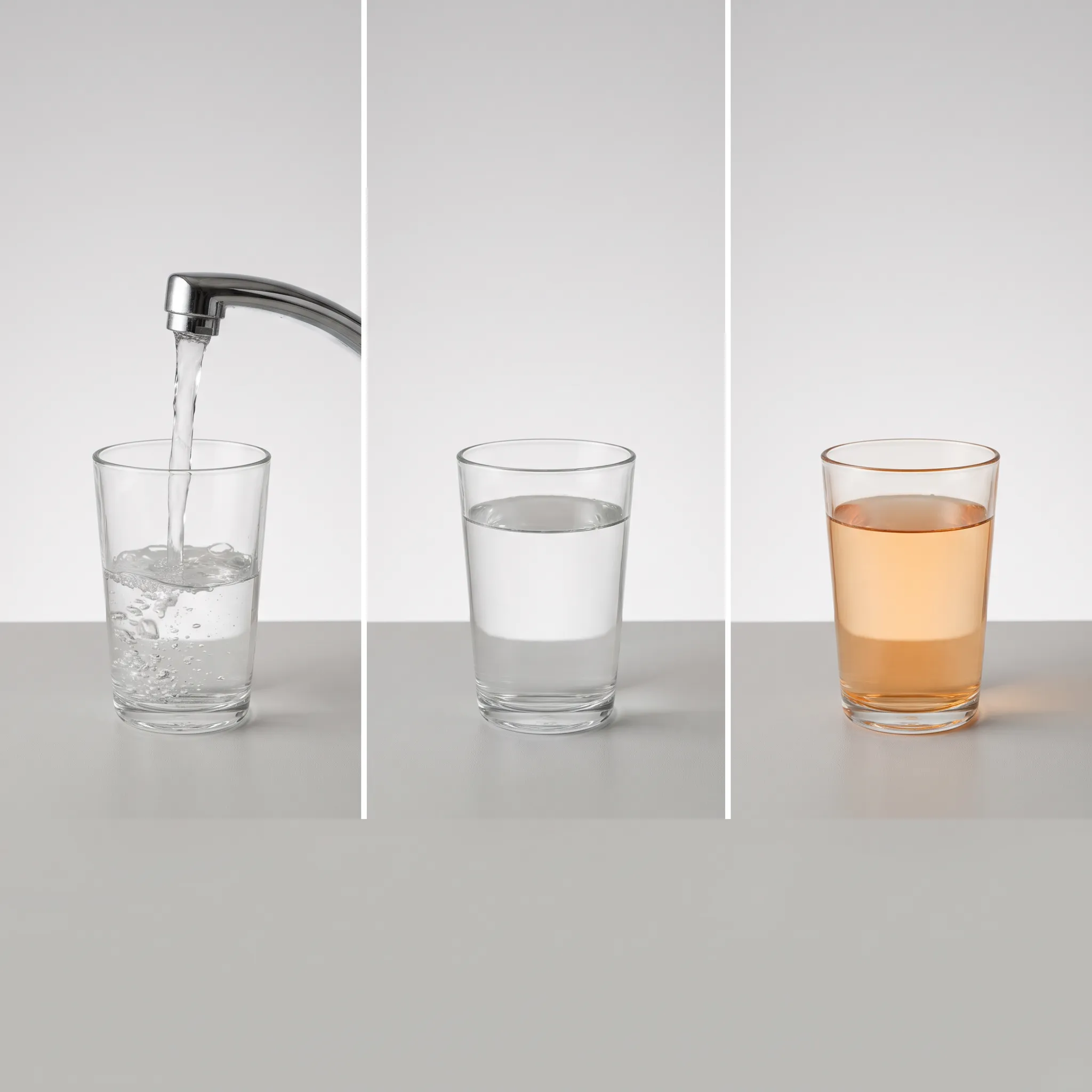
Ferrous iron is dissolved in the water and invisible when it leaves the tap. Once exposed to air, it oxidizes, water that looked perfectly clear can turn yellow, orange, red, or brown after sitting for a while. If your water looks fine at the faucet but color develops in a glass left on the counter, or staining seems to appear “after the fact” rather than immediately, dissolved ferrous iron is a strong possibility. This clear-to-colored pattern is also described in the Minnesota Department of Health’s guidance on iron in well water.
A simple way to screen for this: fill a clear glass straight from the tap, look at it immediately, then check it again after 20–30 minutes. Starting clear and developing color is consistent with dissolved iron oxidizing on contact with air. This tells you about the likely form of the iron, not how much is present, and it isn’t a substitute for a water test.
Ferric Iron (“Red-Water” Iron)
Ferric iron has already oxidized before it reaches your glass, so the water looks reddish, orange, or cloudy right at the tap rather than developing color over time. It often settles as visible sediment or rust-colored particles at the bottom of a glass or a toilet tank. Because it’s already a solid particle rather than something dissolved, it behaves differently in treatment equipment than ferrous iron, a distinction that matters more once you reach the treatment section below.
One complication worth knowing about: organic iron. In some shallow or surface-influenced wells, iron can be bound to natural organic matter such as tannins. That can make the water yellow or brown while also interfering with normal oxidation, which means a softener, aeration system, or standard iron filter may perform poorly even when sized correctly. If your water doesn’t fit the clear ferrous/ferric pattern above, ask that tannins and organic iron be included in the treatment discussion once you’ve tested.
Iron Bacteria
Iron bacteria are microorganisms that interact with iron (and sometimes manganese) in well water, producing a reddish-brown, yellow, or gray slime – often described as a biofilm – along with musty, swampy, or oily odors and sometimes an oily sheen on standing water. It’s most often noticed inside toilet tanks or fixtures that aren’t cleaned often.
Iron bacteria are not known to cause disease. But their presence can create conditions that make it easier for other organisms to grow, so a slime or biofilm pattern shouldn’t be treated as a clean bill of health nor as an emergency. Slime and odor are clues, not proof: laboratory testing is what confirms iron bacteria, and general well-water safety testing is worth doing independently. If you notice a deposit that looks like biofilm during normal cleaning, note its color, texture, and location rather than handling it directly.
At a Glance
| Pattern | What you may see | What happens after standing | Other clues | How to confirm |
|---|---|---|---|---|
| Ferrous (“clear-water”) iron | Water looks clear at the tap | Turns yellow, orange, red, or brown after 20–30 minutes | Staining that seems to develop gradually rather than instantly | Glass observation, then a water test for iron concentration |
| Ferric (“red-water”) iron | Water is already colored or cloudy at the tap | Little change — it’s already oxidized | Rust-colored sediment settles in a glass or toilet tank | Glass observation, then a water test for iron concentration |
| Iron bacteria | Reddish-brown, yellow, or gray slime; musty or swampy odor; possible oily sheen | Slime persists or regrows | Most noticeable in toilet tanks or low-flow fixtures | Laboratory confirmation, not appearance alone |
This table is a starting point for narrowing down what you’re likely dealing with — not a lab result. Two of these problems can also occur at the same time.
Reading the Other Signs: Rusty Water, Stains, Taste, and Timing
Rusty well water and orange or brown staining on fixtures are usually the first thing homeowners notice, and they’re consistent with either ferrous or ferric iron — the color alone doesn’t say which. Brown water straight from the well, rather than water that discolors after sitting, leans toward ferric iron or sediment from the aquifer. A metallic or bitter taste can accompany either form and doesn’t by itself distinguish iron from other dissolved minerals — a supporting clue, not a diagnosis.
Toilet tanks are worth checking because water sits undisturbed there longer than almost anywhere else. Gritty sediment points toward ferric iron; a slimy or stringy texture points toward iron bacteria. If the staining is black or dark gray rather than orange, red, or brown, consider manganese instead, a related but separate mineral with its own thresholds. RuralWaterHQ’s Well Water Problems hub covers that broader symptom map if what you’re seeing doesn’t match the iron pattern here.
It’s also worth checking whether discoloration shows up only in hot water or in both. If it’s hot-only, compare hot and cold taps side by side and inspect the water heater or hot-water plumbing before assuming the well itself is the source, the same hot-vs-cold approach RuralWaterHQ uses for diagnosing rotten-egg odors in well water. Iron and sulfur odor are different problems, but both can turn up in the same well.
Confirming Iron: What Test Do You Actually Need?
Everything above narrows down what you’re likely dealing with. None of it tells you how much iron is actually in your water, and that number is what determines which treatment category applies, a glass observation or a look inside the toilet tank can point toward dissolved iron, oxidized iron, or bacteria, but only a water test gives you a concentration to work with.
A standard iron test is not the same as an iron bacteria test, so if slime, biofilm, or the odors described above are present, say so when you request testing. It’s often worth testing hardness, pH, and manganese at the same time, since all three affect which treatment fits. RuralWaterHQ’s Well Water Testing guide covers choosing between a DIY kit and a certified lab and how often to test — that guidance applies here too, so this article won’t repeat it.
The practical rule holds regardless of what the water looks like: don’t buy treatment equipment before you know what you’re treating. A visual pattern tells you what to ask a lab to test for, not what to buy.
How to Remove Iron From Well Water?: Match the Treatment to the Problem
The right approach depends on whether the iron is dissolved, already oxidized, tied to bacteria, and how concentrated it is. Treating dissolved iron like it’s particulate, or treating iron bacteria like a filtration problem, is a common way homeowners end up with equipment that doesn’t solve what’s actually wrong.
Dissolved ferrous iron
At lower concentrations, ion exchange (the same mechanism used in water softening) can work. At higher concentrations, the more common approach is oxidizing the iron on purpose – aeration or a similar method – then filtering out the resulting solid. Which applies depends on concentration and water chemistry, not just the fact that the iron is dissolved.
Ferric iron
Because it’s already a solid particle, ferric iron behaves more like sediment than a dissolved mineral, so filtration media suited to catching particles can work here in ways that don’t apply to dissolved iron. It’s also why running oxidized iron through a conventional softener isn’t a good long-term plan, resin exchanges dissolved minerals, it doesn’t strain out particles, and oxidized iron will foul it over time.
Iron bacteria
Iron bacteria call for a different response than dissolved or oxidized iron. Depending on how established the problem is, addressing it can involve physically cleaning the affected components, chemical disinfection (chlorine is the most common approach), or both. Because iron bacteria can be difficult to eliminate and treatment may be only partly effective, persistent or established problems are good reasons to involve a licensed well contractor or water-treatment professional, this isn’t a do-it-yourself chemical recipe, and getting the process wrong can make it harder to resolve.
Can a Water Softener Remove Iron?
Yes, sometimes, mainly dissolved ferrous iron at relatively low concentrations, under water chemistry that suits the resin. Beyond that, it depends on several factors together: how much iron is present, whether it’s dissolved or already oxidized, hardness, pH, and the specific resin or media in the system. Penn State Extension guidance describes iron form and concentration, along with hardness and pH, as jointly determining whether a softener is appropriate, and no single number applies to every softener or every well — RuralWaterHQ’s Water Softening & Hard Water guide covers how iron factors into softener sizing in more detail. What holds true across sources is the direction of the limitation: softeners are built for dissolved minerals, and oxidized (ferric) iron is more likely to foul the resin than be removed by it.
What Doesn’t Work or Doesn’t Solve the Whole Problem?
Boiling doesn’t remove iron. As water evaporates, the iron stays behind and can become more concentrated in what’s left. A basic sediment filter catches ferric iron’s particles but does nothing for dissolved ferrous iron, which passes straight through. Filtration alone doesn’t address iron bacteria, since the problem is biological, not just particulate — a filter can trap the debris without touching the source.
Reverse osmosis can remove iron, but it isn’t usually the right first answer for a whole-house problem: RO membranes are built for lower particulate loads, and iron — especially oxidized or bacterial iron can foul or plug a small unit quickly. It’s better suited to polishing a single tap than fixing iron throughout the house.
The most common mistake isn’t a specific technology, it’s buying equipment before testing. The right fix depends on information a lab test provides, not on what a stain looks like.
Iron Treatment Decision Table
Use this to narrow down which category is worth investigating once you have a confirmed problem, not to tell you exactly what to buy. Sizing and equipment selection depend on your actual test results and manufacturer specifications.
If your test results confirm iron and you’re ready to compare treatment systems, our iron filter buying guide walks through matching the system type to your specific water conditions before comparing individual products.
| Problem confirmed | Treatment category to investigate | Why it can work | Main limitation / what to check |
|---|---|---|---|
| Low-level dissolved (ferrous) iron | Ion exchange / water softening | Exchanges dissolved iron for sodium before it can oxidize | Works only within a limited concentration range; hardness and pH affect performance; higher iron will foul the resin |
| Higher dissolved (ferrous) iron | Oxidation followed by filtration | Converts dissolved iron into a solid so it can be physically filtered out | Requires an oxidation step, not just a filter; media needs periodic backwashing or regeneration |
| Ferric (already oxidized) iron | Particulate/media filtration | Iron is already solid, so mechanical or media filtration can capture it directly | Doesn’t address any dissolved iron that’s also present; filter media and micron rating need to match the particle size |
| Iron bacteria | Physical cleaning and/or chemical disinfection (commonly chlorine-based) | Targets the biological source rather than just the resulting debris | Can be difficult to eliminate; treatment may be only partly effective and often needs to be repeated; a licensed well contractor or water-treatment professional is a reasonable step for persistent or established problems |
| Iron combined with manganese | Oxidation and filtration approaches sized for both minerals | Manganese behaves similarly to iron but oxidizes and filters somewhat differently | Manganese has a lower EPA secondary guideline (0.05 mg/L vs. iron’s 0.3 mg/L) and should be confirmed by testing rather than assumed from staining color |
Frequently Asked Questions
Is iron in well water safe to drink?
At the level the EPA’s aesthetic standard addresses, iron itself isn’t classified as a health-based concern. That’s separate from whether the rest of your water is safe, which depends on testing for bacteria, nitrate, and other contaminants iron doesn’t speak to.
Does a water softener remove iron from well water?
Sometimes, mainly dissolved (ferrous) iron at lower concentrations under favorable water chemistry. Oxidized (ferric) iron is more likely to foul the resin than be removed by it.
Does boiling remove iron from water?
No. As the water evaporates, the iron stays behind and can become more concentrated in what’s left.
Does bleach remove iron from well water?
Chlorine can disinfect iron bacteria and can also oxidize dissolved iron into solid particles, but chlorine alone doesn’t remove those particles, filtration is still required afterward.
What is the cheapest way to remove iron from well water?
It depends on the confirmed form and concentration, there’s no universally cheap fix, and testing first is what prevents spending money on a treatment that doesn’t match the problem.
Does reverse osmosis remove iron?
It can, but oxidized or high iron fouls small RO units quickly, so it suits a single tap better than a whole-house fix.
Are iron bacteria dangerous?
Not known to cause disease, but their presence can favor other organisms, confirm with a lab rather than assuming from slime or odor, and test the well for other contaminants independently.
Will shocking a well get rid of iron bacteria?
Chlorine-based disinfection is commonly used, but one treatment doesn’t always fully eliminate it. Repeat treatment is common, and persistent cases are a good reason to involve a licensed well contractor or water-treatment professional.
What to Do Next
- Match what you’re seeing to the patterns above — clear water that discolors later, water that’s already colored, or slime and odor.
- Get it confirmed with a water test, and mention any slime or odor so iron bacteria can be tested for specifically.
- Ask what else is worth testing alongside iron — hardness, pH, and manganese all affect which treatment applies.
- Use the confirmed iron type and concentration to identify the treatment category that fits.
- Only then look at equipment — sizing and selection depend on the test results, not the other way around.
If you’re not sure iron is even the right starting point for what you’re seeing, RuralWaterHQ’s diagnostic tools can help you narrow it down before you test.