

Well water test results often arrive in a lab report full of unfamiliar abbreviations, and the numbers don’t tell you much on their own. The most common mistake homeowners make is comparing a number before checking what unit it’s actually reported in. The second most common mistake is treating every reference value on the page the same way — an MCL, an SMCL, an Action Level, and a Health Advisory are four different things, and none of them is automatically a legal requirement for a private well. This guide walks through your results the same way every time, so you can tell what’s worth acting on and what isn’t.
If you haven’t tested yet, start with our well water testing guide instead — this one picks up after the report is already in your hands.
Table of Contents
Before You Read a Single Number: Check the Unit
Well water reports mix units depending on the lab, the analyte, and sometimes the page. The same number can mean something completely different depending on what follows it — 10 mg/L of nitrate and 10 mg/L of iron aren’t remotely comparable results. Before comparing anything to a reference value, confirm the unit.
| Unit | Common use on well reports | Practical relationship |
|---|---|---|
| mg/L (milligrams per liter) | Most chemical results — nitrate, iron, hardness, TDS | In dilute drinking-water solutions, 1 mg/L is approximately equal to 1 ppm |
| ppm (parts per million) | Same measurements, especially on DIY kit results | Practically equivalent to mg/L at these concentrations |
| µg/L (micrograms per liter) | Trace contaminants — arsenic, lead | Approximately equal to ppb |
| ppb (parts per billion) | Same trace contaminants, some lab formats | Practically equivalent to µg/L |
| Grains per gallon (gpg) | Hardness, especially on softener-focused reports | 1 gpg ≈ 17.1 mg/L as calcium carbonate |
| Presence/Absence | Total coliform, E. coli on most residential panels | A yes/no result, not a concentration |
| CFU/100 mL or MPN | Occasionally used for bacteria instead of presence/absence | Colony-forming units or most-probable-number per 100 mL sample |
These are practical approximations for the concentrations found in drinking water, not a substitute for reading your own lab’s unit label.
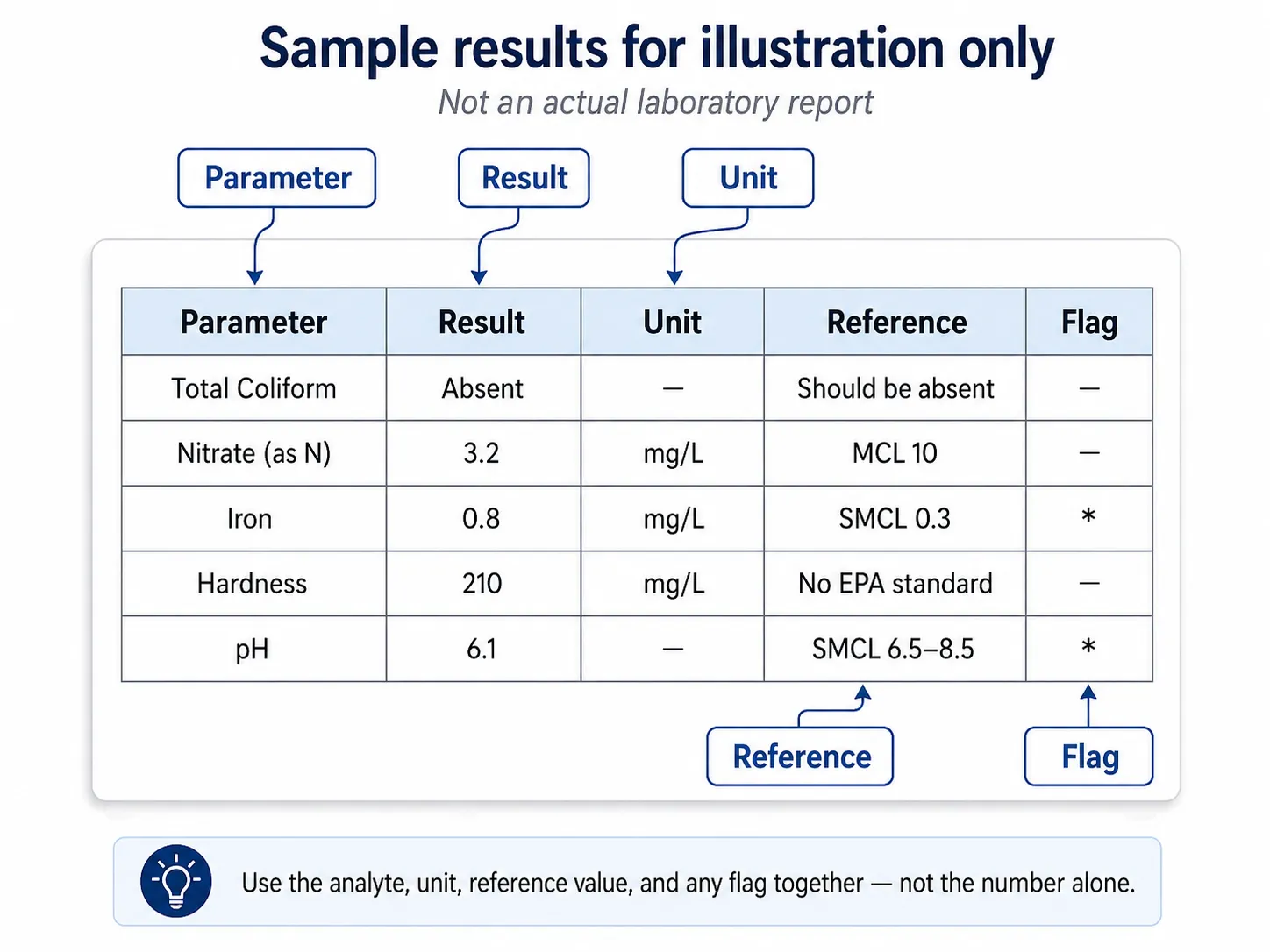
A Repeatable Way to Read Any Well Water Result
Use the same seven steps for every result on the page, whether it’s bacteria, a metal, or a mineral.
- Step 1 — Find the analyte. Locate the exact name of what’s being measured, and watch for versions that look similar but aren’t identical. Nitrate reported “as N” (nitrogen) and nitrate reported “as NO₃” are two different numbers for the same compound — mixing them up changes whether a result looks fine or elevated. If your report doesn’t specify, ask the lab before comparing it to any reference value.
- Step 2 — Check the unit. Worth repeating: the same digit means something different in mg/L, µg/L, ppm, ppb, or grains per gallon.
- Step 3 — Find the reference value. Most labs print a reference or “MCL” column next to your result. If yours doesn’t, EPA’s public drinking-water standards — cited throughout this guide — are the most consistent starting point available to a private-well owner.
- Step 4 — Identify what kind of reference it is. Not every reference value carries the same weight. The next section covers the four you’ll actually run into.
- Step 5 — Compare the reported concentration. Only once the units match. A result of 15 in µg/L is not the same as a reference value of 15 in mg/L — that’s a thousand-fold difference.
- Step 6 — Check for lab qualifier flags. Look for ND, a “less than” symbol, an asterisk, or a code like “J” next to a result — these change what the number means (see the section below).
- Step 7 — Decide what the result actually requires. Not every elevated result calls for the same response. Some warrant prompt attention, some call for confirmation testing, some are about your plumbing rather than your well, and some don’t require any action at all. The safety triage section further down sorts common results into these categories.
MCL, SMCL, Action Level, and Advisory — What They Actually Mean for a Private Well
Private household wells are not regulated by the EPA under the Safe Drinking Water Act, and in most cases not by state governments either. The reference values below were written for public water systems. They’re still the most useful benchmarks available to a private-well owner — there isn’t a separate federal rulebook for wells — but a result above one of these numbers is not a legal violation on your property, and a result below one isn’t a certification that your water is safe. Treat them as reference points, not verdicts.
| Reference type | What it means | Federally enforceable? | How to use it as a private-well owner |
|---|---|---|---|
| MCL (Maximum Contaminant Level) | The highest concentration EPA allows in a public water system for a health-based contaminant | Yes, for public systems | The most useful health-based benchmark available for a well — a result above it is worth confirming and acting on |
| SMCL (Secondary Maximum Contaminant Level) | A non-enforceable guideline for taste, odor, color, staining, or corrosivity | No | Useful for understanding aesthetic and plumbing effects — not a safety threshold |
| Action Level | A regulatory trigger within a specific public-water program (used for lead and copper) | Yes, for public systems, structured differently from an MCL | A reference point, not a personal “safe cutoff” — see the lead section below |
| Health Advisory | Non-regulatory health guidance EPA publishes for a contaminant | No | Useful context, especially where no MCL exists |
| MCLG (Maximum Contaminant Level Goal) | The health goal EPA sets before weighing treatment feasibility — often zero | No | A goal, not a standard — don’t confuse it with the MCL |
In practice, prioritize a result by what the contaminant means for health and exposure — not simply by which regulatory label appears beside it. Health-based MCLs, Action Levels, and Health Advisories serve different purposes, while SMCLs are primarily nuisance or aesthetic guidelines. An SMCL explains why your water tastes, smells, or stains the way it does — not whether it’s safe. An Action Level, which you’ll mainly see for lead, is a regulatory mechanism rather than a personal health threshold. A Health Advisory fills the gap where EPA hasn’t set an enforceable number at all.
What ND, “<”, and Other Lab Flags Mean
ND / Non-detect. The lab didn’t find the analyte at or above the smallest amount its method can reliably measure. That’s not the same as proving zero — it means “not detected by this method,” a meaningful distinction for sensitive contaminants like lead or arsenic.
“<” (less-than symbol). Usually appears in front of a number and means the result is somewhere below that threshold, not equal to it. Your lab’s report should define exactly what threshold it’s using.
Reporting or detection limit. The smallest concentration a lab’s equipment can distinguish from background noise. It varies by method and by lab — it’s a measurement floor, not a safety threshold.
Flags like “J,” an asterisk, or bold text. Labs use these inconsistently. Some mark an estimated value, some flag a result near the reporting limit, some just highlight anything above a reference value. Check your specific lab’s legend before assuming what a flag means.
Presence / Absence. Common for total coliform and E. coli on residential panels. Instead of a concentration, you’ll see a simple present or absent — treat “present” as worth acting on regardless of what accompanying number, if any, appears.
What the Most Common Well Water Test Results Mean
The table below groups results by what you’d actually do about them, not alphabetically. A full explanation of each group follows.
| Result | Common unit | Reference point | Reference type | Plain-English meaning | Typical next step |
|---|---|---|---|---|---|
| Total coliform | Present/Absent | Should be absent | Indicator | A pathway for contamination may exist | Health-relevant — confirm and retest |
| E. coli | Present/Absent | Should be absent | Indicator | Strong evidence of fecal contamination | Health-relevant — use alternate water, contact local health dept. |
| Nitrate (as N) | mg/L | MCL 10 mg/L | MCL | Particular concern for infants under six months | Health-relevant if at/above MCL |
| Arsenic | µg/L or mg/L | MCL 0.010 mg/L (10 µg/L) | MCL | Naturally occurring in some regions’ groundwater | Health-relevant — confirm with certified lab |
| Lead | µg/L or mg/L | Public-system Action Level: 0.015 mg/L now; 0.010 mg/L from Nov. 1, 2027 | Action Level (MCLG = 0) | Usually plumbing-sourced, not from the aquifer | Health-relevant — minimize exposure, confirm, investigate source |
| Fluoride | mg/L | MCL 4.0 mg/L / SMCL 2.0 mg/L | Dual — MCL & SMCL | Different thresholds for health risk vs. cosmetic effect | Context-dependent |
| Iron | mg/L or ppm | SMCL 0.3 mg/L | SMCL | Staining, taste, plumbing fouling | Aesthetic — see iron guide |
| Manganese | mg/L | SMCL 0.05 mg/L; lifetime Health Advisory 0.3 mg/L | SMCL + Advisory | SMCL flags a nuisance level; Advisory flags a health-based one | Context-dependent |
| Hardness | mg/L or gpg | No EPA standard | None | Affects scale, soap performance, appliances | Aesthetic — see softening guide |
| pH | standard units | SMCL 6.5–8.5 | SMCL | Low pH raises corrosivity and can affect lead/copper results | Context-dependent |
| TDS | mg/L or ppm | SMCL 500 mg/L | SMCL | General dissolved mineral/salt load | Aesthetic |
Results that can indicate a health concern
Total coliform. The desired result is absent. A positive result doesn’t automatically mean fecal contamination — it means a pathway into the well may exist (a loose well cap, cracked casing, surface water intrusion). It’s worth confirming with a retest and asking your local health department or certified lab what to check next.
E. coli. The desired result is absent. Unlike total coliform, a positive E. coli result is strong evidence of fecal contamination. It doesn’t tell you which E. coli strain is present. If your result is positive, CDC guidance is direct: don’t drink the water — use bottled water or another safe source, and contact your local health department for specific advice.
Nitrate. EPA’s public-water MCL is 10 mg/L, measured as nitrogen (N) — check that your report uses the same basis, since “nitrate as NO₃” is a different number for the same compound and isn’t interchangeable with “nitrate as N.” The clearest acute concern is for infants under six months. EPA recommends particular attention to well-water testing when a household includes an infant or someone who expects to become pregnant. Boiling doesn’t help — it concentrates nitrate rather than removing it. If your result is at or above the MCL, a local health department or certified lab can advise on retesting and next steps; pregnancy-specific guidance should come from your health care provider or local health department rather than this guide.
Arsenic. EPA’s MCL is 0.010 mg/L (10 µg/L). Arsenic occurs naturally in groundwater in some regions, unrelated to anything on the property. A result at or above the MCL is worth confirming with a certified lab and discussing with your local health department.
Lead. Do not treat 0.015 mg/L (15 ppb) — or the upcoming 0.010 mg/L (10 ppb) — as a personal “safe level.” EPA’s health goal for lead (MCLG) is zero. The 0.015 mg/L figure is the current public-water Action Level, effective since October 2024; a revised 0.010 mg/L Action Level takes effect for public systems on November 1, 2027. Neither number regulates a private well, and an Action Level is a regulatory trigger for utilities, not an individual safety cutoff. Lead in well water is usually not from the aquifer — it’s far more often from household plumbing, solder, or fixtures. If lead is detected, minimize exposure while the source is investigated, confirm the result with an appropriate certified laboratory, and seek guidance from your local health department.
Results that are mostly about taste, stains, and plumbing
Iron. EPA’s non-enforceable SMCL is 0.3 mg/L. Iron above that level typically shows up as staining, a metallic taste, or fouled fixtures rather than a health concern. For the full breakdown of ferrous vs. ferric iron and how to match treatment to the type you have, see our iron in well water guide.
Hardness. EPA has no MCL or SMCL for hardness — there’s no federal reference number at all. What a hardness result tells you is how much scale, soap-performance loss, and appliance wear to expect, not anything about safety. For classification ranges and how to size a solution, see our water softening guide.
Total Dissolved Solids (TDS). EPA’s non-enforceable SMCL is 500 mg/L. TDS is a combined measurement of everything dissolved in the water — minerals, salts, and other compounds — not an identification of any one of them. An elevated, unexplained TDS result is a reason to look at what’s actually contributing to it, which can include naturally occurring minerals or, less often, sulfate (a dissolved ion governed by its own 250 mg/L SMCL). Sulfate is not the same thing as hydrogen sulfide gas, which is what causes a rotten-egg smell and is diagnosed differently. If odor is your actual concern, our rotten egg smell guide covers that directly.
pH. EPA’s non-enforceable SMCL range is 6.5–8.5. pH by itself isn’t a health result, but a low pH increases water’s corrosivity, which can pull lead or copper from household plumbing — which is why a pH result is worth reading alongside a lead or copper result rather than in isolation, if your panel includes both.
Results that need more context than a single number
Manganese. Two different reference values apply, and they shouldn’t be collapsed into one. EPA’s non-enforceable SMCL is 0.05 mg/L, set for aesthetic reasons — dark staining, taste. Separately, EPA’s lifetime Drinking Water Health Advisory for manganese is 0.3 mg/L. Neither is a federal legal limit for a private household well, but they answer different questions: the SMCL flags a nuisance level, and the Health Advisory flags a health-based one. EPA’s manganese advisory specifically notes that for infants younger than six months, the 0.3 mg/L lifetime value should be used even for short-term exposure — including formula prepared with well water — rather than the higher short-term value used for older children and adults.
Fluoride. Two thresholds also apply here. EPA’s MCL is 4.0 mg/L, a health-based limit. Its SMCL is 2.0 mg/L, set for cosmetic effects like tooth mottling in children. A result above 2.0 mg/L but below 4.0 mg/L is above EPA’s secondary guideline while remaining below the current public-water MCL. For a private well, use those values as reference points rather than legal pass/fail limits. If young children in the household drink the water regularly, that’s a question for your pediatric or dental provider rather than something this guide can advise on directly.
Which Results Should You Deal With First?
Not every result belongs in the same bucket.
- Health-relevant, may need prompt follow-up: E. coli, a concerning total coliform result, nitrate, arsenic, lead.
- Mostly aesthetic or equipment-related: iron, hardness, TDS, and moderate pH deviations where no related metal result has been flagged.
- Context-dependent: manganese, fluoride, and pH when read alongside a lead or copper result.
Aesthetic results explain what you’re tasting, smelling, or seeing — they don’t establish anything about overall water safety, and a clean aesthetic result doesn’t offset a health-relevant one elsewhere on the same report.
What to Do After You Read the Report
- Deal with health-relevant findings first. If a bacteria result came back positive, or a chemical result like nitrate, arsenic, or lead was above a relevant health-based reference, that’s where to start — see the sections above for what each one specifically calls for.
- Confirm ambiguous or unexpected results when appropriate — but don’t delay. A single result near a reference value is often worth a retest. If a health-relevant result suggests the water may be unsafe to drink, don’t wait on that retest before switching to bottled water or another safe source and contacting your local health department.
- Check plumbing and source context where relevant. Lead and copper results are frequently about your house, not your well.
- Treat contaminants individually, not as a package. A whole-house system sized for one issue won’t necessarily address another — hardness, iron, and bacteria call for different responses.
- Loop in your local health department or a certified lab for anything health-relevant, and before making a significant treatment decision based on one test.
- Retest after any remediation to confirm it worked, and on whatever ongoing schedule your results and local guidance suggest.
If your report doesn’t explain a symptom you’re actually dealing with — a smell, a stain, low pressure — your results may simply not have tested for the right thing yet. Our well water problems guide helps match symptoms to the right next test.
FAQ
How do I read my well water test results?
Find the analyte, check the unit, find the reference value, identify what kind of reference it is, compare (only once units match), check for lab flags, then decide what the result actually requires. See the full framework above.
Is mg/L the same as ppm?
For the concentrations found in drinking water, yes — mg/L and ppm are practically equivalent, as are µg/L and ppb. They’re not interchangeable with grains per gallon, which is used specifically for hardness.
What does ND mean on a water test?
Not detected — the lab didn’t find the analyte at or above the smallest amount its method can measure. It’s not the same as a confirmed zero.
What are normal well water test results?
There isn’t a single “normal” that applies across every analyte. Each one has its own reference value, and those references are different kinds of numbers — a health-based MCL, a non-enforceable SMCL, an Action Level, or an Advisory. “Normal” depends on which one you’re reading.
Is 10 mg/L of nitrate safe?
10 mg/L as nitrogen is EPA’s public-water MCL, used here as the standard health-based reference point for private wells too. It’s not a legal limit on your well specifically. At or above that level, it’s worth confirming with a retest and checking with your local health department, particularly if infants under six months or pregnant household members are drinking the water.
What does a high iron result mean?
Almost always an aesthetic and plumbing issue — staining, taste, fouled fixtures — rather than a health concern. See our iron in well water guide for the full breakdown by iron type.