

When well water smells like rotten eggs, the cause is almost always hydrogen sulfide (H2S) gas, produced by sulfur bacteria in your well, your plumbing, or very often, inside your water heater. The smell is unpleasant but the diagnosis is refreshingly mechanical: two quick tests at your own taps usually pinpoint the source, and the source determines whether the fix costs $30 or $1,500.
The 2-minute diagnosis
Test 1 — Hot vs. cold. Run the cold tap only, then the hot tap only, and smell each.
| Result | Source | Fix range |
|---|---|---|
| Smell only in HOT water | Water heater – anode rod reaction | $30–$150 (anode swap) |
| Smell in hot AND cold | Well water itself, or plumbing biofilm | Test 2 ↓ |
Test 2 — Treated vs. untreated. If you have any filtration, smell water before and after it; and compare a tap far from the softener with one after it. Smell that appears only after the softener points to sulfur bacteria colonizing the resin bed, fixed with resin-bed cleaning, not a new system.
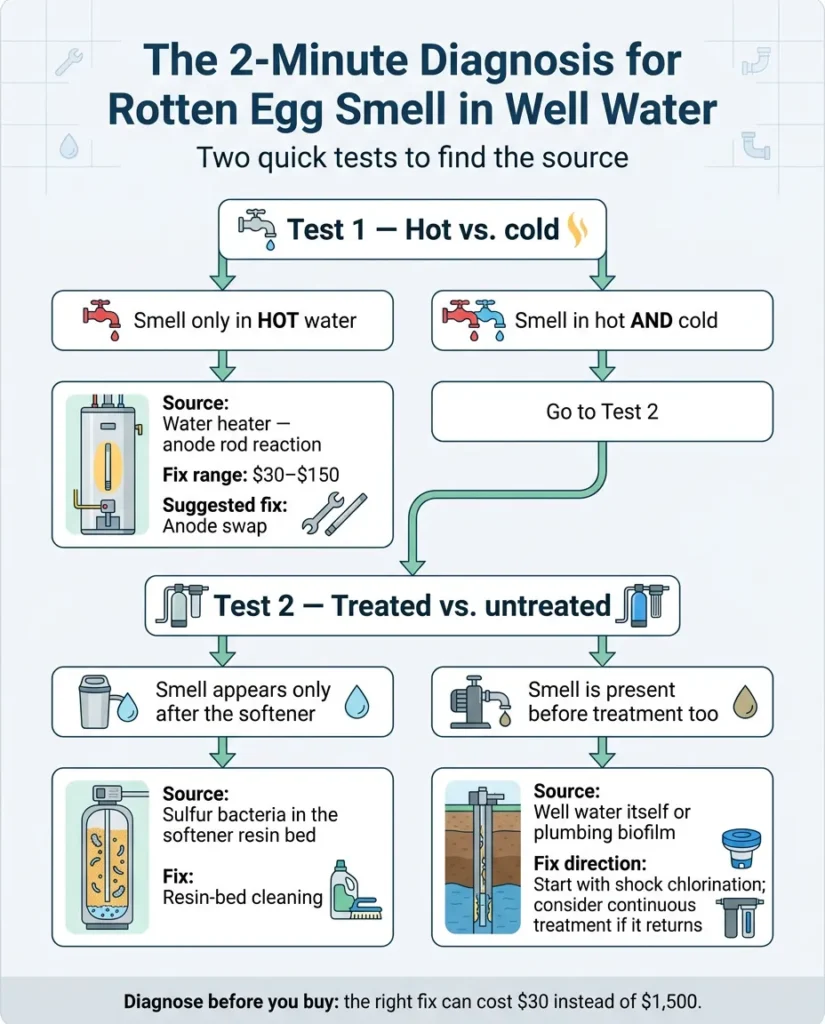
Fix 1: The water heater (the most common and cheapest)
If only hot water smells, the magnesium anode rod in your heater is reacting with naturally occurring sulfates. Swap it for an aluminum-zinc anode rod ($25–$60) or, on problem water, a powered (impressed-current) anode ($100–$150). While you’re at it, flush the tank and, if the smell is strong, sanitize with a peroxide flush. This single fix resolves a large share of sulfur complaints before anyone sells you a whole-house system.
Fix 2: Shock chlorination (bacteria in the well)
If both taps smell and the well is the source, start with shock chlorination: a controlled dose of chlorine through the well casing and plumbing, left to sit 12–24 hours, then flushed. Kits cost $20–$50 and the procedure is a homeowner job with precautions (bypass softeners and carbon filters, don’t run chlorinated water to the septic in volume). It kills the existing bacterial colony; if the smell returns within weeks, the bacteria are being continuously fed and you need continuous treatment ↓.
Fix 3: Continuous treatment (persistent H2S)
| H2S level | Best technology | Typical installed cost |
|---|---|---|
| Under ~1–2 ppm, light smell | Catalytic carbon filter | $400–$900 |
| ~2–8 ppm | Air injection / oxidation (AIO) system | $800–$1,800 |
| 8+ ppm or with heavy iron/manganese | Chlorination + retention + carbon | $1,500–$3,000 |
Note the pattern: AIO systems also remove iron and manganese, which very often travel with sulfur in the same wells. If well water smells like rotten eggs and also leaves orange stains, one properly sized AIO unit treats all three – see our well water problems hub for the combined diagnosis, and get an actual H2S number from a test before sizing anything (testing guide — H2S degrades in shipped samples, so use an on-site test or a lab that provides a field kit).
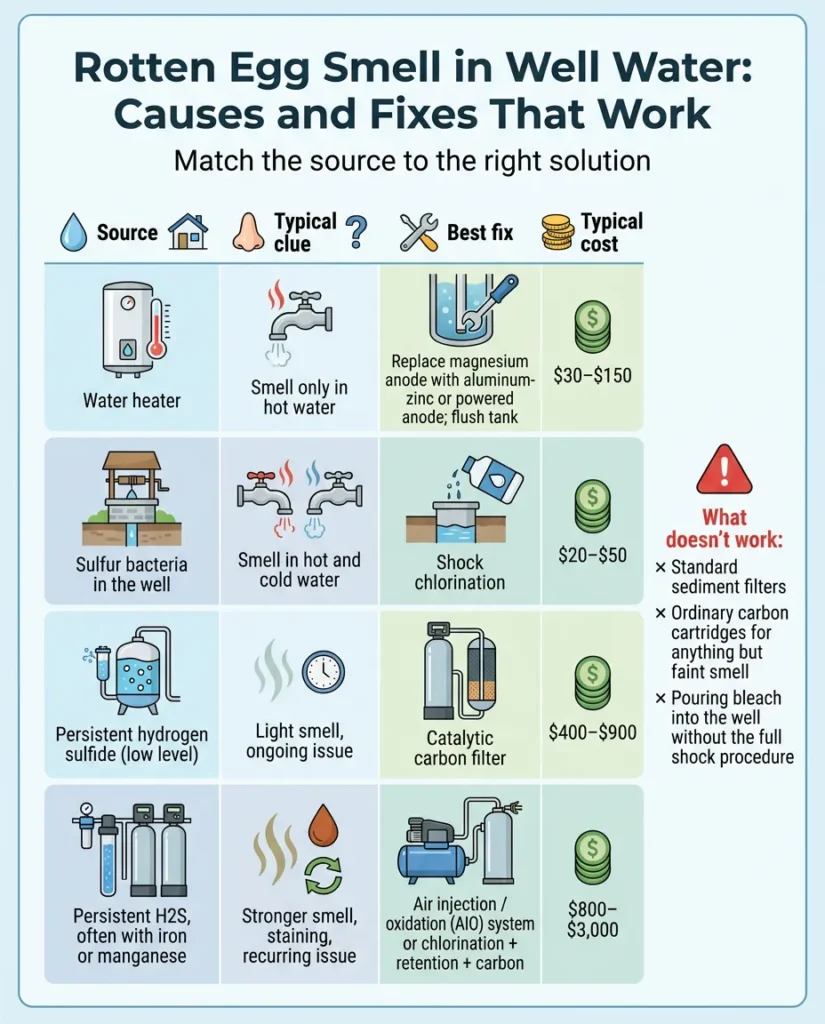
What doesn’t work
Standard cartridge sediment filters (H2S is a dissolved gas, it passes straight through), ordinary carbon cartridges on anything but the faintest smell (they exhaust in weeks), and pouring bleach down the well without the full shock procedure (temporary at best, and skips the plumbing where biofilm lives).
Still have questions about why well water smells like rotten eggs? Here’s what homeowners ask most often.
FAQ
Is it dangerous if well water smells like rotten eggs?
At the concentrations typical in wells, H2S is a nuisance rather than a health hazard; but it’s corrosive to plumbing and silver, and strong smells warrant a full water test since sulfur bacteria conditions can accompany other issues.
Why does the smell come and go?
Bacterial activity varies with water use and temperature. Smell that’s worst in the morning or after time away points to gas accumulating in stagnant lines classic biofilm behavior.
Will a water softener remove the sulfur smell?
No. Softeners exchange hardness minerals; they don’t remove dissolved gases. Worse, sulfur bacteria can colonize the resin bed and become the smell’s source.
How much does it cost to fix sulfur smell in well water?
From about $30 (anode rod) to $50 (shock chlorination) to $800–$1,800 (AIO system) depending on the source and concentration, which is exactly why you diagnose before you buy.