
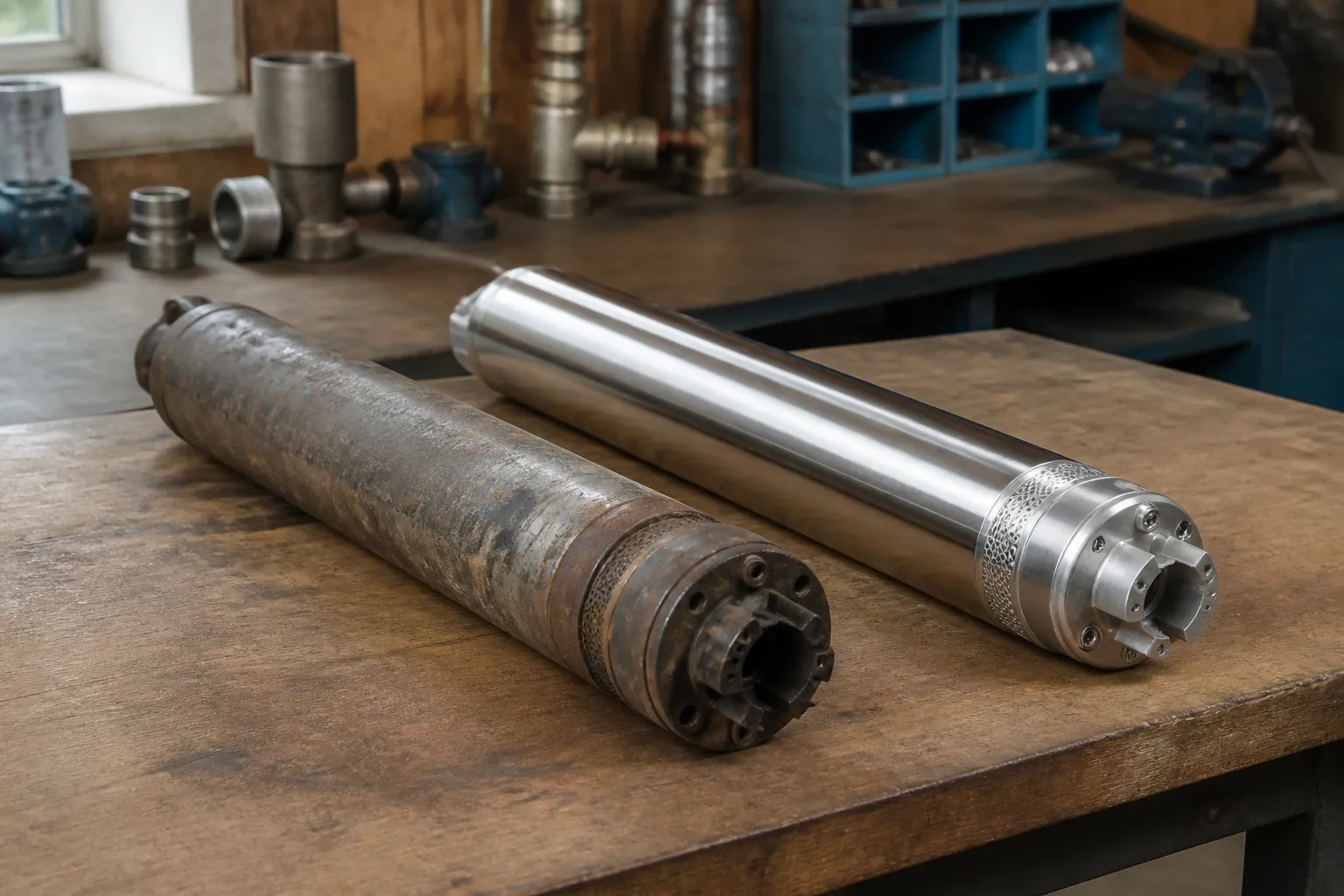
A professional residential well pump replacement commonly falls around $900 to $3,000 installed, though a straightforward shallow jet-pump swap can cost less, and a deep, high-horsepower, difficult-access, or constant-pressure system can cost substantially more. Several current national cost guides put their average or central estimate at roughly $1,800 to $1,900, a useful benchmark, but not a promise about what your specific job will cost.
Three things drive most of that spread: which type of pump you have (an above-ground jet pump costs less to swap than one submerged hundreds of feet down a well), how deep and accessible your well is, and how much pipe, wire, or control equipment gets replaced along with the pump itself.
One caution before you budget for any of this: if nobody has actually confirmed that the pump or motor has failed, start with our well pump troubleshooting guide first. A lot of "no water" problems turn out to be something far less expensive than a new pump.
Well Pump Replacement Cost at a Glance
| Pump / job type | Current published installed range | What usually drives the range |
|---|---|---|
| Shallow-well jet pump | $400–$1,800 | The low end represents a straightforward, above-ground shallow-well swap; cost rises with pump quality, added plumbing work, or tank replacement |
| Convertible / deep-well jet pump | $500–$2,500 | More complex ejector plumbing and somewhat more labor than a basic shallow-well jet pump |
| Standard residential submersible pump | $1,000–$3,000 | The most common well pump replacement; price depends heavily on depth, horsepower, and how accessible the well is |
| Deep, high-horsepower, or difficult submersible job | Can exceed $3,000 and reach $5,500+ in current published estimates | Extra drop pipe and wire, more pump-pulling labor and equipment, larger horsepower |
| Constant-pressure / VFD system | Roughly $2,000–$5,000+ | Higher equipment cost for the pump-and-controller package; scope changes further if you’re converting from a conventional system |
These figures are synthesized from several current published cost guides, not a guarantee of what any specific contractor will quote you, use them to sanity-check a quote, not to predict it exactly.
This table focuses on the conventional residential setups most homeowners are actually comparing quotes against. Specialty solar and windmill systems are outside this article's core residential replacement scope, so they are not included as separate rows.
Pump Hardware vs. Installed Replacement Cost
This distinction matters more than almost anything else on this page, because it's where a lot of sticker shock comes from.
Hardware only. A pump purchased at retail can cost only a few hundred dollars, residential pump hardware alone often runs from a few hundred dollars into the low four figures, depending on pump type, horsepower, brand, and capacity. Current cost guides commonly describe pump-unit-only pricing somewhere in the roughly $300–$1,500 range depending on horsepower and pump type; treat any specific hardware figure as a snapshot, since retail pump pricing shifts with the market.
Installed price. This is what most homeowners are actually asking about, and it typically bundles some combination of:
- the pump itself
- labor
- pulling and reinstalling the old unit
- fittings
- the electrical connection
- standard installation materials
A full submersible-system refresh goes further and may also include:
- drop pipe
- pump wire
- a check valve
- a control box
- pitless-adapter work
- other worn components identified during the job
This is why a $600 pump can turn into a $2,500 job. The pump itself may be a modest line item next to the labor, pipe, wire, and fittings that go with it, especially on a deep submersible replacement where the whole assembly has to come out of the well and go back in.
-
Pump type
Above-ground, submersible, or constant-pressure equipment
-
Well depth
More pipe, cable, weight, and pulling work
-
Access / pulling labor
Site access and equipment needs change the job
-
Pipe, wire & components
Condition determines what else may be replaced
-
Emergency / regional conditions
Timing, travel, labor rates, and local requirements
Varies by job — see the table above for current published ranges.
Cost by Pump Type
Shallow-Well Jet Pump
Shallow-well jet pumps sit above ground, usually in a basement, crawl space, or pump house, not down in the well. That above-ground accessibility is the main reason this is typically the least expensive replacement category: there's no deep pump pull, and the labor involved is generally simpler than a submersible job. Cost still varies with pump quality, tank condition, and any plumbing changes the job requires.
Convertible / Deep-Well Jet Pump
A convertible jet pump can be configured for shallow- or deep-well service. When configured for deeper-well use, it commonly uses a two-pipe arrangement with the ejector located down in the well, which makes the plumbing more complex than a basic shallow-well jet setup. That added complexity, and the somewhat greater labor it takes to get right, is why this category typically costs more than a basic shallow-well jet pump.
Submersible Well Pump
Submersible pumps are common in modern drilled residential wells and account for a major share of the replacement-cost questions homeowners ask, which makes this the core subsection of most well pump replacement quotes.
A submersible pump sits down inside the well itself, sometimes hundreds of feet below the surface, and it has to be pulled up and a new one lowered back into place as part of any replacement. That means more pipe and wire are involved than with an above-ground pump, and labor and access matter a great deal, a well that's easy to reach with the right equipment costs less to service than one that isn't. Depth is one of the strongest factors in submersible well pump replacement cost, for reasons covered in the next section.
Deep or High-Horsepower Submersible Pump
The deeper the well and the larger the pump, the more the job tends to cost qualitatively, this comes from more drop pipe and wire, more suspended weight to manage, larger and more expensive equipment, and often more specialized labor to pull and reset the assembly safely. Current published estimates show that deep, high-horsepower, or difficult-access submersible jobs can move well above the standard $900–$3,000 range, with some guides placing complex jobs in the $3,000–$5,500+ range. That reflects what can happen on a harder job, not how often jobs land there nationally. This guide won't tell you what horsepower to choose; that's a system-design decision, not a shopping decision (more on that below).
Constant-Pressure / VFD System
A constant-pressure (variable-frequency-drive) system uses a different pump-and-controller package than a conventional switch-and-tank setup, and that package typically costs more than an equivalent conventional pump. If you're converting from a conventional system to constant-pressure rather than replacing an existing VFD system in kind, the scope – and the cost – can change further, since it may involve controller work beyond a simple pump swap. This guide doesn't recommend specific brands or walk through VFD setup or programming; that belongs with whoever installs the system.
How Well Depth Changes the Cost?
Greater well depth generally increases replacement cost, because there's more drop pipe, more electrical cable, more suspended weight, and more labor involved in pulling and reinstalling the pump. That's a directional relationship, not a formula, there's no single national per-foot rate you can multiply by your well's depth to get a reliable number for your job.
Current cost guides use several different ways to illustrate the effect of depth, some price pipe and cable per foot, while others use broad depth bands or additional-cost estimates per 100 feet. Those methodologies do not line up closely enough to support a national per-foot formula. The defensible takeaway is simpler: deeper wells generally require more pipe, more cable, more suspended weight, and more pump-pulling labor.
Horsepower Can Raise Equipment Cost – But Don't Size a Pump by Price
Larger, higher-horsepower pumps generally cost more to buy and install than smaller ones. But horsepower alone doesn't tell you what pump you actually need.
Correct sizing depends on your well's pumping water level, the system's total dynamic head, the flow rate you need, your well's yield, and how the rest of your system is set up, not on what fits the budget. If you're replacing a pump, don't assume the new one should automatically match the horsepower of the old one, and don't let a lower price talk you into an undersized unit. A qualified well or pump professional should size the replacement to your well and system, the same way the original pump was – or should have been – sized in the first place; local licensing requirements for who can do this work vary by jurisdiction.
What Else Can Be Added to the Quote?
A well pump replacement quote can include more than just the pump. Common additions:
- Drop pipe : the pipe that suspends the pump and carries water up the well
- Pump wire : the electrical cable that runs down to the pump
- Check valve : prevents water from draining back down the pipe between pump cycles
- Control box : required on some three-wire submersible motors
- Fittings and pitless-adapter work : the connection point where the underground line meets the well casing
- Pressure switch and pressure tank : separate components covered in more detail below
Contractors may recommend replacing aging or questionable pipe and cable while the pump is already out, since it's already exposed and accessible. Whether that makes sense for your job depends on the condition, age, and material of what's already down there, the well's depth, and what the contractor actually finds, there's no blanket rule that the pipe and wire must always come out with the pump.
Repair or Replace the Well Pump?
Current US cost guides put many well pump repairs around $375–$1,600, with averages close to $950–$1,000. That's a repair figure, not a replacement figure, keep the two separate when you're comparing a repair estimate against a full replacement quote.
Useful factors for deciding between repair and replacement include:
- whether a professional has actually confirmed motor or pump failure (as opposed to a control component)
- the pump's age
- whether it's had repeated repairs
- whether the failed item is really a pressure switch or other lower-cost control component rather than the pump itself
- visible corrosion or damage to the pump or drop pipe
- overall well condition
- whether the pump is still under manufacturer or installer warranty
This guide won't hand you a universal rule, no fixed percentage-of-replacement-cost threshold, no "repair under X years, replace after Y years" cutoff. Those thresholds show up in some competitor content, but they're house rules of thumb, not something the current evidence supports as a national standard. A confirmed motor or pump failure, an older pump, a history of repeated repairs, or visible corrosion can strengthen the case for replacement, but none of those factors decides it on its own; your specific pump's condition and a professional's diagnosis matter more than any generic formula.
Lifespan. Several current homeowner cost guides cite roughly 10–15 years as a broad service-life reference for residential well pumps, but this is not an expiration date or a replacement rule — service life varies substantially with cycling frequency, water quality, sizing, usage patterns, well conditions, and equipment quality, and not every pump type ages the same way. A pump doesn't need to be replaced automatically at year 10 or year 15; age is one input into a repair-or-replace decision, not the decision itself.
Before You Authorize a New Pump
This is worth slowing down for, because it's the step that saves the most money.
A "no water" or low-pressure problem doesn't automatically mean the pump has failed. It can come from several different places:
- the pressure switch
- the pressure tank
- other control equipment
- an electrical problem (breaker, wiring, connection)
- short cycling caused by a tank issue rather than the pump
- or, yes, an actual pump or motor failure
Sometimes the failed component is a much cheaper pressure switch or control component rather than the pump itself. The only way to know which one you're dealing with is to work through it — which is exactly what our other guides are for:
Well Pump Not Working — start here if you haven't diagnosed the problem yet
Well Pump Pressure Switch Problems — for switch-related symptoms specifically
Well Pump Short Cycling — for rapid on/off cycling, which often points to the tank rather than the pump
The key message: a replacement quote only makes real sense once the pump or motor has actually been identified as the failed component, not before.
Do You Need a New Pressure Tank Too?
No. Pump replacement does not automatically require pressure-tank replacement.
The pump and tank are separate components with separate failure modes, and the tank should be evaluated on its own condition rather than swapped by default just because the pump is being replaced. That said, the two do interact: short cycling can come from a pressure-tank/precharge problem or another system issue rather than pump failure. A tank/precharge problem can cause excessive cycling and increase the number of pump starts, which is why the tank should be evaluated separately before it is bundled into a pump-replacement job. If you're not sure which one is actually the issue, our well pump short cycling guide walks through how to tell the difference.
There's no reliable age-based rule for when a tank "must" be replaced, and this guide isn't going to invent one. A tank in good working condition doesn't need to come out just because the pump is being swapped — and a bundled pump-and-tank replacement should be something a professional actually finds necessary, not something assumed by default.
How to Read a Well Pump Replacement Quote?
A written quote is the best tool you have for understanding what you're actually paying for. Before you sign off, it's reasonable to ask whether the quote includes:
- the pump's make, model, and horsepower/capacity
- labor, including pulling and reinstalling the pump
- drop pipe
- wire
- check valve
- control box, if your system uses one
- pressure tank — only if it's actually being replaced and why
- permits, if applicable in your area
- any emergency or after-hours service-call charge
- disposal of the old equipment
- a workmanship warranty separate from the manufacturer's product warranty
This guide isn't going to hand you a "fair price" line-item labor rate — legitimate rates vary too much by region and contractor for that to be honest. What it can offer is this checklist, so you're comparing apples to apples.
For scheduled, non-emergency work, it's worth comparing two or three written quotes where that's practical. That said, if your household is genuinely out of water, this isn't the moment to delay an urgent repair indefinitely just to keep shopping balance due diligence against how urgent your situation actually is.
Emergency and After-Hours Replacement
After-hours, weekend, and emergency service commonly carries additional labor or service-call charges, but the size of that premium varies widely by contractor and location current cost guides describe this differently enough (some as a percentage surcharge, others as a change in the hourly labor rate) that there isn't one reliable national figure to quote you. Ask for the emergency or service-call fee up front, before authorizing the job, when your circumstances allow you that time.
Regional Pricing, Permits, and Licensing
Installed cost isn't uniform across the country. Local labor rates differ, travel distance to rural properties differs, typical well depths differ by region and geology, and permit or licensing requirements for well work vary by state and county.
Because that variation is real and locally specific, this guide isn't going to publish a state-by-state price table or a permit requirement that applies everywhere, it wouldn't be accurate, and rules change. Check your state or county well program, local health department, or a licensed pump contractor for the requirements that actually apply where you live.
Can You Replace a Well Pump Yourself?
It depends heavily on which type of pump you have.
Above-ground jet pumps are more physically accessible, you can see and reach the whole unit without going into the well. But "accessible" isn't the same as "simple": the job still involves plumbing work, an electrical connection, setting up the pressure system correctly, and priming the pump. This guide isn't a step-by-step replacement tutorial, and getting any of those steps wrong can mean anything from a leak to a safety hazard.
Submersible pumps are a different story, and professional replacement should be the default here for most homeowners. The pump and drop pipe form a suspended assembly that may run hundreds of feet down the well, and pulling and resetting it typically requires the right lifting equipment, a safe electrical splice at depth, and care to protect the well's sanitation and structural integrity. This guide won't walk through pump-pulling rigs, hoisting methods, electrical splicing, wiring diagrams, or any other DIY submersible replacement steps for good reason. If you're not confident you have the equipment and experience this job calls for, hiring it out is the right call.
Does Homeowners Insurance Cover Well Pump Replacement?
If a well pump needs replacement because of age, deterioration, normal wear and tear, or ordinary mechanical breakdown, a standard homeowners policy typically will not pay simply to replace the worn-out equipment. Coverage may be different when the pump is damaged by a sudden event that is covered by the policy, and optional equipment-breakdown coverage can apply differently depending on the insurer and endorsement.
Insurers sometimes point to things like a lightning strike, fire, or storm damage as examples of the kind of sudden, covered event that can trigger coverage, but these are examples of the category of loss that may be covered under some policies, not a promise that any specific cause is automatically covered for your pump. The actual policy language, cause of loss, coverage limits, deductible, and endorsements control the answer.
Check your policy or ask your insurer or agent before assuming a replacement will be covered. This isn't individualized insurance advice, it's a starting point for the conversation you should have with whoever holds your policy.
Check the Pump Warranty Before Paying
Before you authorize a full replacement, it's worth a few minutes to check whether your existing pump is still under warranty. Identify the pump's make, model, and serial number or manufacture date, and dig up any installer paperwork you have. A manufacturer warranty may cover the defective product itself without covering removal, labor, travel, or reinstallation, so "under warranty" doesn't automatically mean "free to replace." Warranty terms vary significantly by product, manufacture date, registration status, installer, seller, and jurisdiction, which is exactly why this guide isn't going to generalize one brand's warranty terms to every pump on the market. Your installer or a call to the manufacturer with your model and serial information is the reliable way to find out what's actually covered.
FAQ
How much does it cost to replace a well pump?
Most professional residential replacements fall around $900–$3,000 installed, with several current national estimates centering around roughly $1,800–$1,900. The actual number for your job depends on pump type, well depth, access, and how much else (pipe, wire, tank, control equipment) gets replaced alongside the pump.
How much does a submersible well pump cost to replace?
A standard residential submersible replacement typically runs $1,000–$3,000 installed. Current published estimates show that deep, high-horsepower, or difficult-access jobs can move well above that range, with some guides placing complex jobs in the $3,000–$5,500+ range — that reflects what can happen on a harder job, not how often jobs land there.
How much does a jet well pump cost to replace?
Shallow-well jet pumps typically run $400–$1,800 installed, with straightforward above-ground swaps at the lower end. Convertible or deep-well jet pumps, which use a more complex plumbing configuration, typically run $500–$2,500 installed.
How long does a well pump last?
Many current homeowner cost guides cite roughly 10–15 years for a residential well pump, but service life varies substantially with cycling, water quality, sizing, usage, well conditions, and equipment quality — it isn't an expiration date, and a working pump doesn't need to be swapped just because it's crossed that range.
Is it cheaper to repair or replace a well pump?
It depends on what's actually failed. Repairs commonly run $375–$1,600, averaging around $950–$1,000 — much less than most replacements. But that math only holds if the problem really is repairable; a confirmed motor or pump failure, an aging pump with a history of repeated repairs, or significant corrosion can strengthen the case for replacement. There's no universal percentage or age cutoff that makes this call for you — it depends on your pump's actual condition.
Can I replace a well pump myself?
An above-ground jet pump is more physically accessible, though it still involves plumbing, electrical work, and priming that need to be done correctly. A submersible pump is a different situation — professional replacement is the safer default, given the depth, the lifting equipment involved, and the downhole electrical connection/splice associated with a submersible pump.
Do I need a new pressure tank when I replace the pump?
No, not automatically. The pump and tank are separate components with separate failure modes, and the tank should be evaluated on its own condition rather than replaced by default. A failing tank can cause symptoms that look like a pump problem, so it's worth ruling out before assuming you need both.
Does homeowners insurance cover a well pump?
Not for ordinary age, deterioration, or mechanical breakdown — a standard policy typically won't pay to replace equipment that simply wore out. Coverage may apply if the pump was damaged by a sudden event the policy covers, and an optional equipment-breakdown endorsement can change the answer further, but the actual policy language and cause of loss control it. Check with your insurer before assuming either way.
Why is well pump replacement so expensive?
Because the price reflects more than just the pump: pulling a submersible unit out of a deep well takes specialized labor and equipment, the job often involves replacing pipe, wire, and fittings alongside the pump, and depth and access both add real time and complexity to work that has to be done correctly the first time.