
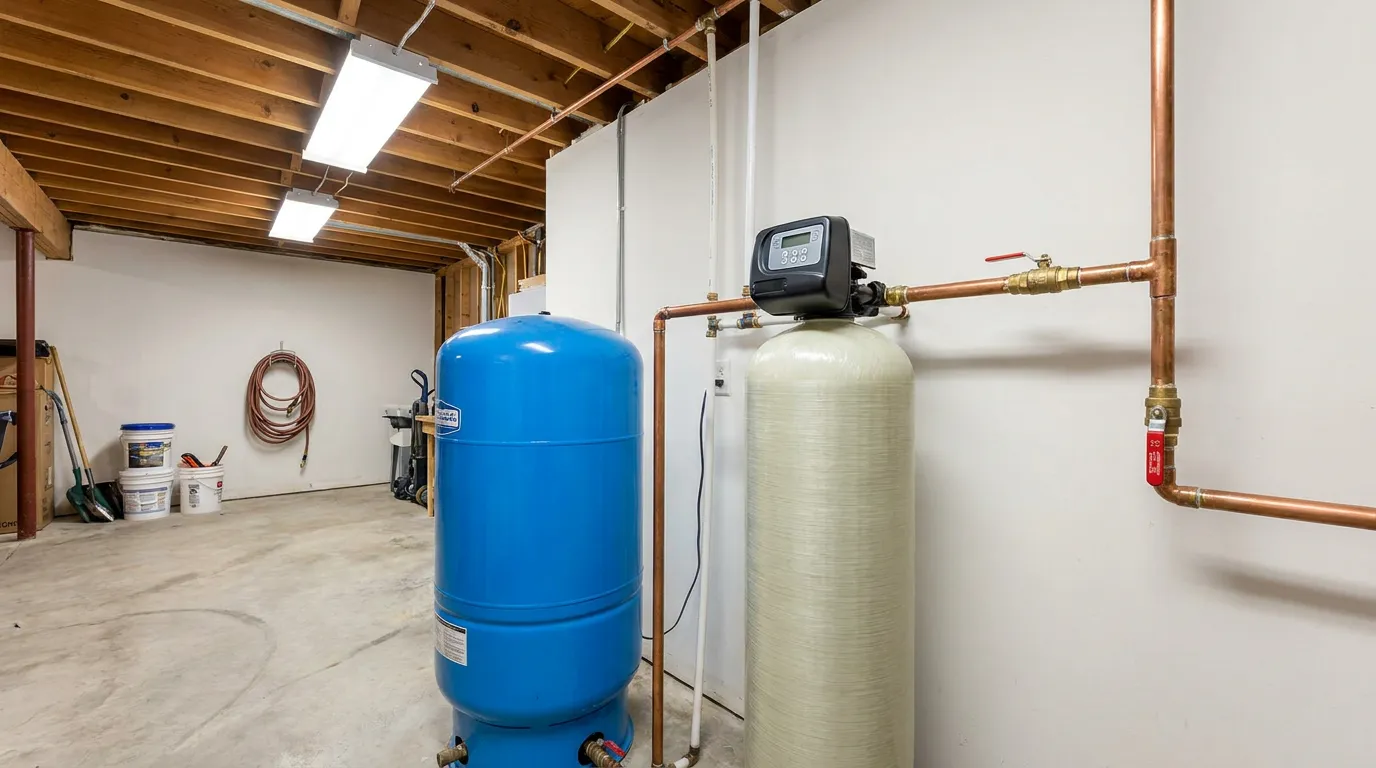
If you’re not yet sure whether iron is actually behind your staining, discoloration, or metallic taste, start with our iron in well water guide, it covers what causes iron problems and how to tell iron apart from manganese or iron bacteria. This guide picks up from there: you already know iron is the issue, and you’re ready to choose the right iron filter for well water.
There’s no single “best” iron filter for well water. The right system depends on your water, specifically your confirmed iron concentration, the form the iron is in, your water’s pH, and whether manganese or sulfur odor are also present. Even systems marketed under the same broad technology label can differ enormously: verified manufacturer specifications for air-injection-oxidation (AIO) systems in this guide range from roughly 7 ppm of iron capacity to 30 ppm, depending on the brand. That’s not proof that one system is better than another, it’s proof that “AIO” by itself isn’t a specification.
This guide walks through matching your water to a treatment category first, then compares specific systems within each category using verified manufacturer data and independent water-treatment guidance. That process helps you choose an iron filter for well water based on evidence rather than a generic “best” label.
How We Chose the Systems in This Guide?
This guide is based on verified manufacturer specifications, published operating requirements, warranty terms, and certification claims pulled directly from each manufacturer’s current documentation, cross-referenced against independent water-treatment guidance from extension-service research and public health guidance. RuralWaterHQ did not physically test these systems. Where a manufacturer states a certification (NSF, WQA, ANSI, etc.), we’ve noted exactly what that mark covers where we could confirm it, rather than treating any certification badge as a blanket performance guarantee. Where a specification wasn’t published or couldn’t be confirmed, we labeled it “not stated” rather than filling the gap from a retailer listing or a third-party review.
What You Need to Know Before You Shop?
Iron concentration. An actual number matters more than a color. “My water is orange” tells you almost nothing about how much iron you’re dealing with — a light stain and a heavy stain can both come from water that looks similar out of the tap. Selecting equipment from staining alone, without a lab or reliable test-kit result in hand, is how homeowners end up either underpowered for their actual water or paying for capacity they don’t need. If you haven’t tested yet, our well water testing guide covers how, and our guide to reading your results can help you understand what your specific numbers mean before you start comparing systems.
Iron form. Ferrous (clear-water) iron, ferric (already-oxidized, red-water) iron, and organic iron behave differently in a treatment system, and iron bacteria is a different problem entirely (more on that below). Our iron in well water guide covers how to tell these apart, that detail isn’t repeated here.
pH. Several oxidation-based media have an effective pH range, and performance can drop outside it. Some manufacturers publish a specific range; others don’t state one at all on their product pages, which is itself worth asking about directly before you buy, don’t assume a system will perform consistently across every pH level just because pH isn’t mentioned.
Manganese and sulfur. Many of the same systems that treat iron also address manganese and hydrogen sulfide (the rotten-egg smell), but not always at the same capacity, a system’s stated iron capacity doesn’t tell you its manganese or sulfur capacity. If your water smells like sulfur rather than just staining, our rotten egg smell guide covers that specifically.
Iron bacteria. This deserves its own short note because it’s not just another row on a capacity chart. If your water shows a slimy or gelatinous buildup, a rainbow-like sheen, or a swampy/musty odor, that points toward iron bacteria, a biological problem, not just a mineral one. A standard iron filter is not automatically the fix. Iron bacteria typically needs to be addressed through well disinfection or remediation before (or alongside) any filtration decision, not treated as one more contaminant a filter will simply remove. If this sounds like your water, see the iron bacteria section of our iron in well water guide before shopping for a system.
Match Your Water to a Treatment Category
-
Test your water
Get a real lab or test-kit result rather than judging by color, smell, or staining alone.
-
Identify your conditions
Iron concentration, iron form, pH, manganese or sulfur presence, and whether iron bacteria is involved.
-
Choose a treatment category
Match your confirmed conditions to a category — softener, AIO, catalytic media, or chemical injection.
-
Compare specific systems
Within that category, compare manufacturer-stated specifications for individual models before buying.
Use the table below to identify which category is worth investigating for an iron filter for well water — not which product to buy. Sizing and final equipment selection depend on your actual test results and the manufacturer’s published specifications for the exact system you’re considering.
| Your confirmed water situation | Treatment category to investigate | What to verify before buying |
|---|---|---|
| Low, dissolved (ferrous) iron, alongside genuine hardness | A water softener may handle a limited amount of ferrous iron as a secondary benefit of hardness treatment. | Confirm the iron is dissolved (ferrous), not already oxidized (ferric). Confirm no iron bacteria is present – bacteria and ferric iron both tend to foul softening resin. |
| Moderate iron, water chemistry suited to oxidation media, no iron bacteria | Air Injection Oxidation (AIO) or a catalytic/oxidizing media system. | Get the manufacturer’s specific iron-capacity and pH-range figures in writing for the exact model – capacity varies significantly between systems marketed under the same technology label. |
| Higher iron, or iron combined with manganese and/or sulfur odor | A higher-capacity oxidation system, or – where the confirmed load calls for it – chemical injection ahead of filtration. | Compare each candidate system’s manufacturer-stated capacity for iron and for manganese/sulfur separately. A higher price doesn’t automatically mean higher capacity, and ongoing chemical cost applies only to injection-based systems. |
| Low pH | pH correction or neutralization, investigated before or alongside whichever iron-treatment system you select. | Ask what pH range the specific media or system requires to perform as rated – this varies by manufacturer and isn’t always published. |
| Signs of iron bacteria — slime, a rainbow-like sheen, or a swampy/musty odor | Well remediation or disinfection evaluation. This is not ordinary filter shopping. | Get iron bacteria specifically identified before buying filtration equipment. See the iron bacteria differentiation section of our iron in well water guide. |
| Multiple, unrelated water issues alongside iron | A broader whole-house treatment design, rather than selecting an iron-only system in isolation. | Get a full-panel water test so any additional treatment steps are based on confirmed results, not assumptions carried over from the iron issue alone. |
General category guidance above draws on independent, but dated, extension-service research into iron treatment methods; it is not a substitute for the current published specification of the exact system you’re considering. Always confirm against the manufacturer’s current documentation before buying.
From Category to System
Once you know which category fits, the next question is what that category actually involves day to day and then which published system specifications match your numbers.
Water softeners. A water softener is built to remove hardness minerals, not iron, but under the right conditions (low, dissolved ferrous iron, alongside genuine hardness), a softener can handle a limited amount of iron as a secondary benefit. It is not a universal iron filter for well water. Ferric (already-oxidized) iron and iron bacteria both tend to foul softening resin rather than being removed by it. If a softener is on your list, our best water softeners for well water comparison covers current systems and iron limits, our water softening guide covers sizing and hardness in detail, and the grain capacity calculator on our tools page factors in dissolved iron alongside hardness and household size.
Air Injection Oxidation (AIO). For an iron filter for well water, AIO systems inject an air pocket into the tank to oxidize dissolved iron into particles, then trap those particles in a media bed and flush them out on an automatic backwash cycle. They’re chemical-free, which is a big part of their appeal, and they require electricity and a drain line for backwashing. What they don’t have is a standardized capacity: as noted above, manufacturer-stated iron capacity for systems in this category varies substantially, you cannot assume “AIO” alone tells you what a given system can handle. Get the specific manufacturer’s number, in writing, for the exact model you’re considering.
Catalytic and oxidizing media. Some systems use a catalytic or oxidizing media bed (with or without an air-injection stage) to speed up the oxidation-and-trapping process, and these can be more sensitive to pH than a simple mechanical filter. Media-based systems still require periodic backwashing and, over time, media replacement. This guide won’t turn into a materials-science breakdown of every media type on the market, the point that matters for buying is: ask what pH range the media needs, and what happens to performance outside that range.
Chemical injection plus filtration. When an iron filter for well water must handle iron levels that exceed what a chemical-free system is designed to handle, or for combined heavy iron-and-sulfur loads, some systems inject an oxidizer – commonly hydrogen peroxide – ahead of a filtration stage. This adds real capability at the high end, but it also adds an ongoing chemical supply to buy and refill, plus injection-pump equipment to maintain. It isn’t automatically the “stronger” or “better” choice for every household, it’s the right tool when your confirmed water conditions genuinely call for it, and the tradeoff is more moving parts to maintain.
Systems to Consider
The systems below are grouped by the category they fit, not ranked against each other – each iron filter for well water listed here serves a different confirmed water situation – a “good fit for moderate, confirmed iron” system and a “good fit for high iron” system aren’t competing for the same reader. We excluded systems whose key treatment specifications couldn’t be verified from adequate primary documentation during this review; a shorter, well-supported list is more useful than a longer one padded with unverified specs.
Disclosure: This page contains affiliate links. If you buy through them, RuralWaterHQ may earn a commission at no extra cost to you. Recommendations follow the manufacturers’ own documents, not commission availability.
| System | Treatment approach | Manufacturer-stated iron capacity | Also addresses | Backwash | Chemicals | Best fit | Important limitation |
|---|---|---|---|---|---|---|---|
| SpringWell Whole House Well Water Filter | Air Injection Oxidation | Up to 7 ppm – manufacturer stated | Manganese up to 1 ppm; H₂S up to 8 ppm – manufacturer stated | Yes, automatic nightly | None | Moderate, confirmed iron; wants chemical-free operation | Manufacturer-published pH range: 6.5–10; a water test is required as part of the purchase process before the order is finalized |
| SoftPro AIO Iron Master | Air Injection Oxidation | Up to 30 ppm — manufacturer stated | Manganese up to 7 ppm — manufacturer stated; H₂S addressed, but the main product page does not state a numerical limit | Yes, automatic. Size selector lists minimum flows of 5, 7 and 10 GPM for the 1.0, 1.5 and 2.0 cu. ft. models; confirm exact pump/backwash requirements before ordering. | None | Best for High Iron — Chemical-Free AIO | NSF/WQA/ANSI/IAPMO/ISO 9001 marks are shown on the product page, but the specific standard each mark applies to is not detailed there — treat as a manufacturer-stated certification claim, not an independently confirmed performance certification, until verified directly |
| US Water Systems Flexx Oxi-Gen | Aeration / air injection | Up to 8 ppm — manufacturer stated | Manganese up to 0.5 ppm; H₂S up to 6 ppm — manufacturer stated | Yes, automatic | None | Moderate iron where a published pH range matters to your decision (manufacturer states 6–9) | Manufacturer states this system is not recommended where iron- or sulfur-reducing bacteria are present |
| US Water Systems Flexx InFusion | Hydrogen peroxide injection + filtration | Up to 10 ppm — manufacturer stated | H₂S up to 15 ppm; manganese up to 0.5 ppm — manufacturer stated. Manufacturer states pH range 6.5–8.5. | Yes, required at specified flow rates | Continuous hydrogen peroxide injection — ongoing supply required | Severe or combined iron-and-sulfur loads that exceed chemical-free system ratings | Requires ongoing chemical purchase and injection-pump maintenance that the chemical-free systems above don’t; the manufacturer advertises a one-year satisfaction guarantee, which is separate from product warranty coverage |
Not stated on a manufacturer’s current product page is shown as such rather than filled in from a retailer listing or third-party source. Pricing changes frequently with sales and sizing and is not included in this table — see the cost section of the article and confirm current pricing directly with the manufacturer.
Chemical-free AIO, moderate confirmed iron: SpringWell’s whole-house iron filter is built around a nightly automatic backwash cycle and no chemical dosing, with a manufacturer-stated capacity of up to 7 ppm iron, 1 ppm manganese, and 8 ppm hydrogen sulfide. The manufacturer currently publishes a pH range of 6.5–10. SpringWell requires a water test (currently sold as part of the purchase process) before the order is finalized, worth knowing going in, since it means you can’t skip straight from checkout to installation.
SoftPro AIO Iron Master: Best for High Iron
SoftPro’s AIO Iron Master is rated by the manufacturer for meaningfully higher capacity – up to 30 ppm iron and 7 ppm manganese – using the same chemical-free, automatic-backwash approach. This is the clearest example of the capacity-variance point above: two chemical-free AIO systems, a more than 4x difference in stated iron capacity.
SoftPro’s current size selector lists minimum flows of 5, 7 and 10 GPM for the 1.0, 1.5 and 2.0 cu. ft. models respectively. Confirm pump/backwash requirements for your exact model before ordering.
SoftPro’s page displays NSF, WQA, ANSI, IAPMO, and ISO 9001 marks; the specific standard each mark applies to isn’t detailed on the product page itself, so treat these as manufacturer-stated certification claims rather than independently confirmed performance certifications until you’ve verified the underlying standard with the manufacturer directly.
Aeration-based AIO with a published pH range: US Water Systems’ Flexx Oxi-Gen is a chemical-free, air-injection/aeration system rated for up to 8 ppm iron, 0.5 ppm manganese, and 6 ppm hydrogen sulfide, and the manufacturer publishes an effective pH range (6 to 9) directly on the product page. The manufacturer also states this system is not recommended where iron- or sulfur-reducing bacteria are present, which lines up directly with the iron-bacteria caution earlier in this guide.
Chemical injection, for severe or combined loads: US Water Systems’ Flexx InFusion uses continuous hydrogen peroxide injection ahead of filtration, manufacturer-rated for up to 10 ppm iron and 15 ppm hydrogen sulfide within a stated 6.5–8.5 pH range. It requires an ongoing peroxide supply and injection-pump upkeep that the chemical-free systems above don’t, a real maintenance tradeoff in exchange for handling higher combined iron-and-sulfur loads than the chemical-free options in this guide.
How Much Does an Iron Filter for Well Water Cost?
Choosing an iron filter for well water also means budgeting for the equipment and ongoing maintenance.
Pricing shifts with sales, sizing, and options, so treat these figures as a dated snapshot rather than a quote. Prices checked September 26, 2026: SoftPro listed its 1.0 cu. ft. base model at $1,517 and larger variants up to $1,897; SpringWell listed $2,231.25–$2,677.50 before its required $134.25 water test; Flexx Oxi-Gen variants were $2,230.14–$2,792.06; and Flexx InFusion variants were $2,255.36–$2,613.51. Add-ons, installation, larger tank sizes, and sales can change the total. Chemical-injection systems also add an ongoing oxidizer cost. Confirm current pricing directly with the manufacturer for your exact model and size.
What to Verify Before You Buy?
Before buying an iron filter for well water, confirm each of the following, ideally from your own test results and the manufacturer’s current documentation, not from a retailer’s summary of either:
- Your actual water-test results – iron concentration, iron form, pH, and whether manganese or hydrogen sulfide are also present.
- The manufacturer’s stated contaminant capacity for the exact model you’re buying, not the technology category in general.
- Service flow rate, separately from contaminant capacity – a system can be rated for a given ppm level and still need to be sized for your household’s actual peak water demand. Capacity, flow rate, and household demand are three different numbers; don’t assume one implies the others.
- Backwash requirements – how often, how much water, and whether you have a suitable drain.
- Electrical requirements at the install location.
- Ongoing costs – chemical refills if applicable, and expected media life.
- Warranty terms, read in full rather than assumed from marketing language.
- The exact certification standard, if certification matters to your decision – ask what the mark specifically covers (material safety, lead-free compliance, performance) rather than treating any certification logo as proof of iron-removal performance on its own.
Frequently Asked Questions
What is the best iron filter for well water?
There isn’t a single best system — the right one depends on your confirmed iron concentration, iron form, pH, and whether manganese or sulfur are also present. Use the decision table above to identify your category, then compare manufacturer-stated specifications for models within that category.
How much does an iron filter for well water cost?
Base configurations from the brands covered here started at roughly $1,500–$2,300 when prices were checked September 26, 2026, while larger variants reached about $2,800. Required testing, installation, options, and chemical refills can add to the total. Confirm current pricing directly with the manufacturer.
Do I need a water softener or an iron filter?
It depends on your iron level and form. A water softener may handle a limited amount of dissolved (ferrous) iron alongside genuine hardness, but an iron filter for well water is the better match for ferric (red-water) iron or higher concentrations; iron bacteria can foul softening resin. If you’re not sure which applies, your test results — not the softener’s marketing copy — should decide.
Will an iron filter remove manganese?
Many iron treatment systems also address manganese, but not necessarily at the same capacity as their iron rating. Check the manufacturer’s manganese-specific number for the exact model — don’t assume it matches the iron figure.
Can a whole-house filter remove iron?
A whole-house system built specifically for iron removal (the categories covered in this guide) can, if it’s correctly sized and matched to your water’s iron level and form. A general-purpose whole-house filter that isn’t designed for iron oxidation and capture is a different product and generally isn’t built for the job.
Can an iron filter remove iron bacteria?
Not reliably, and not as its primary function. Iron bacteria is a biological problem that typically needs well disinfection or remediation, separate from — and usually before — any standard filtration equipment. If your water shows slime, a sheen, or a musty odor, treat that as a different problem than ordinary iron staining.
How do I know which iron filter I need?
Choosing an iron filter for well water starts with a real water test, then use the decision table above to match your confirmed conditions to a treatment category, and finally compare manufacturer-stated specifications for specific systems within that category. Skipping straight from “my water looks bad” to a specific product is the most common way homeowners end up with the wrong system.