
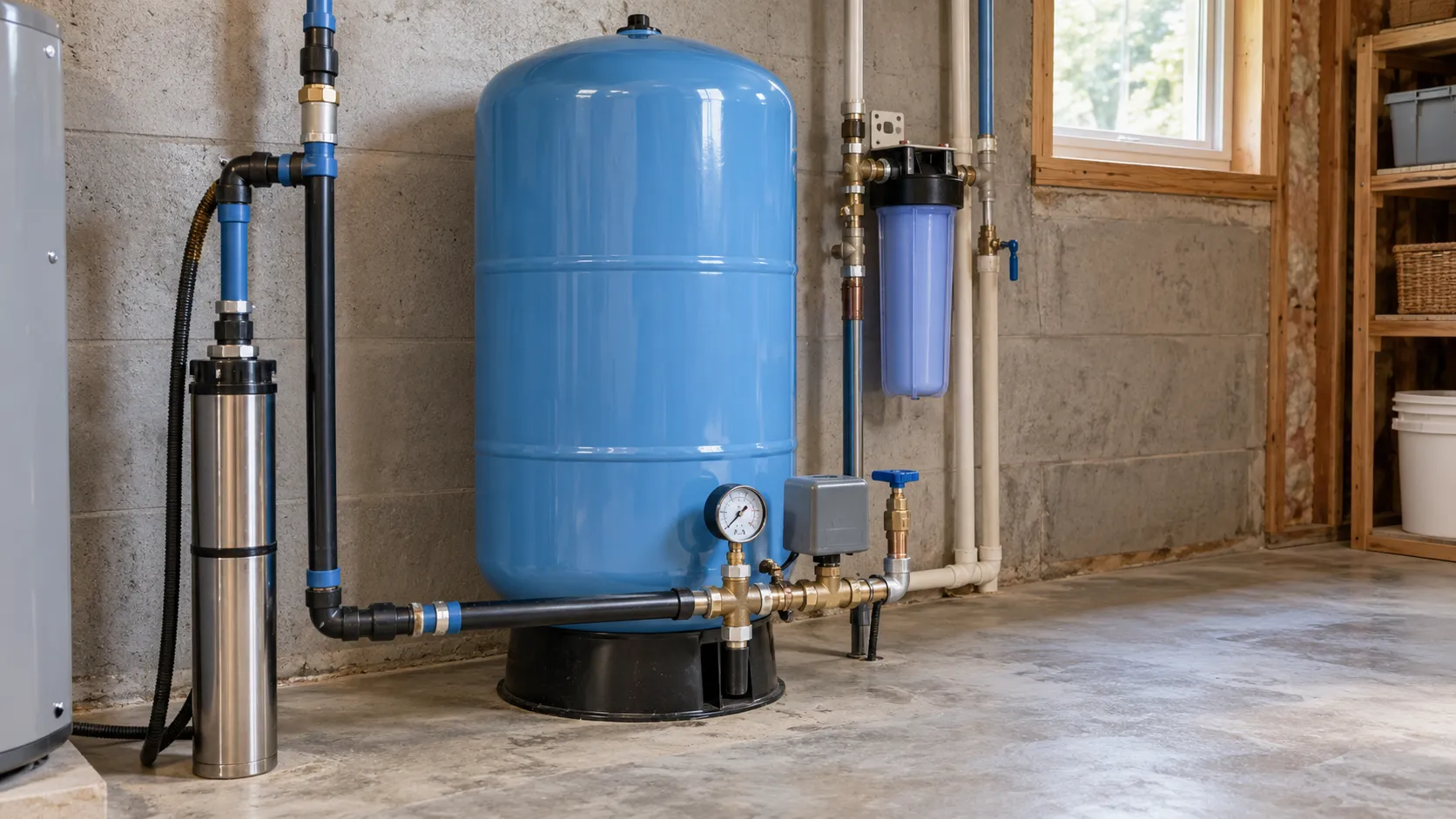
Table of Contents
Well Pressure Tank Replacement Cost at a Glance
| Job type | Hardware only (observed retail) |
Published installed estimates (2025–2026) |
What usually moves the price |
|---|---|---|---|
| Small tank, 20–32 gal | $210–$710 | $450–$1,350 | Construction, access, whether the switch is replaced too |
| Mid tank, 40–44 gal | $500–$865 | $600–$1,600 | Size, brand/construction tier, basement vs. crawlspace access |
| Large tank, 62–86 gal | $1,060–$1,150 | $750–$2,300 | Weight/rigging for a large tank, disposal of the old one |
| Emergency / after-hours | Same hardware price | Add a same-day or off-hours premium† | Dispatch timing, local parts availability |
† No reliable sourced figure exists for a typical emergency surcharge — see “Emergency and After-Hours Replacement” in the article.
Disclosure: This page contains affiliate links. If you buy through them, RuralWaterHQ may earn a commission at no extra cost to you.
Observed retail examples used to establish these hardware ranges included the Water Worker HT-20B and Global Water Solutions PressureWave PWN-US-80LV, PWN-US-130LV, and PWN-US-160LV.
Hardware figures are observed retail examples across multiple brands and constructions per size band – not a market average – checked live at SupplyHouse.com, aquascience.net, Home Depot, and doitbest.com, 11 Sep 2026 (full detail in Section 10). Installed figures are the ranges published by HomeGuide, The Well Guide, and findmywelldriller.com as of their last update, three sources that don’t agree closely with each other, which is itself useful: installed pricing varies more by region and contractor than hardware pricing does.
Tank Price vs. Installed Cost: What You’re Actually Paying For?
A pressure-tank quote is really several line items pretending to be one number. The tank itself is a manufactured product with a knowable price; everything else – labor, fittings, removal of the old tank, and how hard it is to reach – is local and variable, which is why two contractors can quote the same job $600 apart without either being wrong.
Hardware price is driven mostly by size and construction (more below). Labor is driven by the plumber’s hourly rate, findmywelldriller.com and HomeGuide both put typical well-service labor at $75–$150/hour, with HomeGuide estimating $250–$500+ in labor for a full swap. Fittings usually add a modest amount over tank price, and removal of the old tank is often bundled into labor. Access, an open basement versus a tight crawlspace or buried pit, can move labor time more than tank size does.
None of the three cost sources we reviewed separates these cleanly. The table below at least separates tank price, which we could verify directly, from the installed range, reported as published estimates.
Tank Size, Drawdown, and Price by Model
Drawdown figures below come directly from each manufacturer’s own specification documentation, not from retailer copy. Nominal tank volume and usable drawdown are different numbers — see “Why Drawdown Matters More Than Gallons” in the article.
| Model | Construction | Nominal volume | Drawdown at 30/50 psi switch |
Max pressure | Verified retail price |
|---|---|---|---|---|---|
| Amtrol Well-X-Trol WX-202 | Steel | 20 gal | 6.2 gal | 150 psig | $331.00 |
| Pentair WellMate WM-9 | Fiberglass composite | 29.5 gal | 9.1 gal | 125 psi | $705.55 |
| Amtrol Well-X-Trol WX-203 | Steel | 32 gal | 9.9 gal | 150 psig | $524.53 |
| Pentair WellMate WM-12 | Fiberglass composite | 40.3 gal | 12.5 gal | 125 psi | $863.13 |
| Amtrol Well-X-Trol WX-250 | Steel | 44 gal | 13.6 gal | 150 psig | $708.87 |
| Amtrol Well-X-Trol WX-251 | Steel | 62 gal | 19.2 gal | 150 psig | $1,141.00 |
| Amtrol Well-X-Trol WX-255 | Steel | 81 gal | 25.0 gal | 150 psig | $1,059.99 |
| Amtrol Well-X-Trol WX-302 | Steel | 86 gal | 26.6 gal | 150 psig | $1,150.00 |
Drawdown: Amtrol Inc., Well-X-Trol brochure (MC10188-04_24_WXT-brochure.pdf, 05/24) and Amtrol’s Well-X-Trol installation/owner’s manual; Pentair WellMate WM900 composite pressure tank catalog. Retail prices: SupplyHouse.com (Amtrol) and aquascience.net (WellMate), checked 11 Sep 2026 — see Retail Price Verification Matrix for exact listing pages. This table omits models we could price at retail but could not verify against current manufacturer drawdown documentation.
Nominal tank size – the number in the model name – isn’t what matters for choosing a replacement. What matters is drawdown: how many gallons the tank actually delivers on its own air charge before the pump restarts. Drawdown depends on nominal volume and the pressure switch setting it’s paired with, the two aren’t interchangeable. Amtrol’s own specification chart lists the 32-gallon WX-203 at 9.9 gallons of drawdown on a 30/50 switch setting but only 8.6 gallons on 40/60. Both settings have the same 20-psi spread between cut-in and cut-out, the difference isn’t a wider swing, it’s a higher absolute pressure range. By Boyle’s Law (pressure × volume stays constant for a fixed trapped-air charge), the same 20-psi swing is a smaller volume change higher up the pressure scale, so the tank delivers less usable water even though nothing about the tank changed. The gallon number on the box tells you the container size, not the delivery.
It’s tempting to buy “the same size as what’s coming out” without checking whether that was ever right. To confirm sizing rather than replace like-for-like, use the site’s pressure tank sizing calculator, a five-minute job with your pump’s flow rate and switch setting, not something this guide teaches mid-breakdown.
Steel, Composite, or Fiberglass? Where the Price Spread Comes From?
Nearly all residential pressure tanks used for standard well-pump cycling – the kind this guide covers – are precharged bladder or diaphragm tanks. Older air-over-water tanks needing periodic manual air pumping have mostly been superseded for this use, though they persist in some specialized water-treatment systems (aeration, sulfur, or methane treatment). Within precharged tanks, construction mainly separates a $330 tank from an $860 tank of similar drawdown.
Steel tanks (Amtrol’s Well-X-Trol line) are rated to a higher maximum working pressure – 150 psig, per the manufacturer’s installation manual – and carry a 7-year limited warranty. They’re the most common tank sold through big-box and plumbing-supply channels, and heavier for a given capacity.
Composite/fiberglass tanks (Pentair’s WellMate line) trade some pressure rating – 125 psi maximum, per Pentair’s WM900 catalog – for corrosion resistance steel can’t offer. The brands’ NSF-related claims aren’t equivalent: Amtrol’s brochure says its diaphragm “meets stringent NSF STD 61 requirements,” a manufacturer self-declaration, while Pentair’s WellMate documentation says its tanks are WQA-tested and certified (independent third party) to NSF/ANSI 61 Section 8 and NSF/ANSI 372. Neither is the “better” claim, just different kinds of statement.
Neither construction is universally better. Fiberglass doesn’t rust the way steel can, a real advantage near standing moisture, but neither manufacturer quantifies how much longer that makes a tank last, so treat it as a documented difference, not a number of extra years. Confirm warranty terms directly with your retailer or installer, Amtrol states a clear 7-year term; Pentair’s catalog states none.
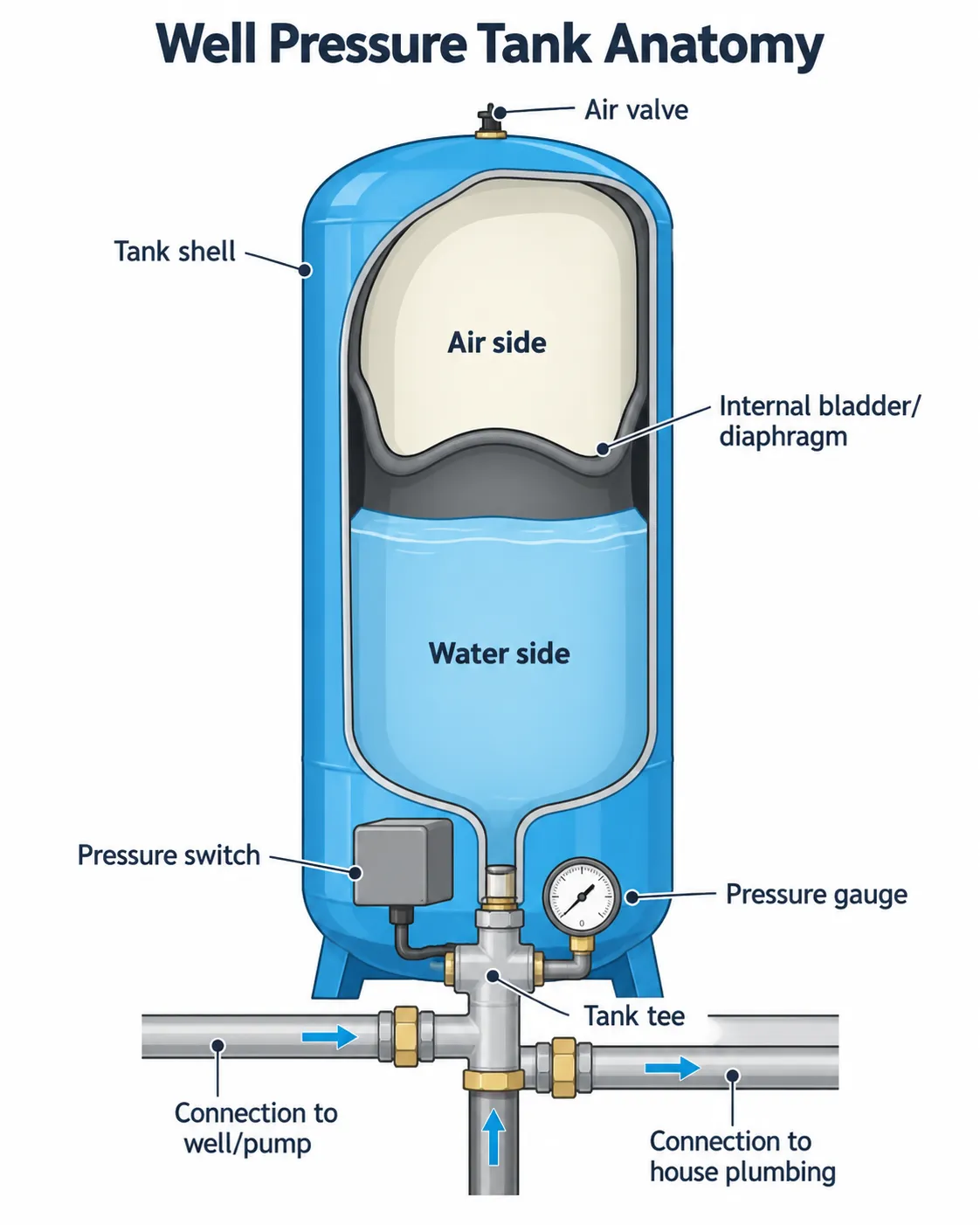
Before You Buy a Tank: Make Sure the Tank Is the Problem
A pressure tank, a pressure switch, and a failing pump can all produce a similar-feeling symptom – the pump running too often – and only one of those fixes costs what this guide describes. Before authorizing a tank replacement, it’s worth ruling out the cheaper parts first.
A pressure-switch problem tends to show up as chatter clustered around one point, without a clean cut-in-to-cut-out rhythm. A tank or precharge problem looks different: pressure climbs to cut-out quickly, then falls back to cut-in within seconds, with little usable water delivered in between. A pump or wiring problem is different again, often with no pressure buildup at all.
RuralWaterHQ’s well pump short cycling guide covers this distinction in detail, and well pump pressure switch problems covers the switch side specifically. If you haven’t gone through that diagnostic step, it’s worth five minutes before spending several hundred dollars on a tank that might not be the actual failure.
Is It the Tank, the Switch, or the Pump?
A quick gut-check before you buy — not a full diagnosis. For the complete walkthrough, see the linked guides below.
-
Does the pump cycle on and off rapidly while water runs?
If yes, that pattern points toward the tank or its air charge, not the pump itself. Continue to step 2. If no — for example, no pressure builds up at all — this points more toward the pump or wiring, and this cost guide isn’t the right starting point. See Well Pump Not Working instead.
-
Is the cycling a clean, fast rhythm — or scattered chatter?
A clean, fast cut-in-to-cut-out rhythm with very little water delivered between cycles usually points to the tank or precharge. Scattered chatter clustered around one pressure, without that clean rhythm, points more toward the pressure switch. See Well Pump Pressure Switch Problems for the switch-specific pattern.
-
Has a diagnostic check found water — not air — at the tank’s air valve, or confirmed an internal bladder/diaphragm failure?
If a professional or a proper diagnostic check confirms water at the Schrader (tire-style) valve, or an internal air-cell/bladder/diaphragm failure, that generally points toward tank replacement or a manufacturer-specific internal repair — which one depends on the exact model. See Well Pump Short Cycling for how this shows up in practice, then come back here for pricing.
-
Is it just air, and the bladder seems intact?
A low air charge on an otherwise intact tank is often a precharge issue, not a replacement issue — but checking or adjusting precharge on an installed, in-service tank should be done by a qualified professional, per the manufacturer’s own installation documentation, not as a homeowner DIY step. Background on why is covered in Well Pump Short Cycling. If precharge turns out fine and the tank is still cycling fast, replacement is the likely next step — the pricing below is for you.
Can a Pressure Tank Be Repaired Instead of Replaced?
Sometimes. It depends on what actually failed – and on the specific tank.
A lost or low air charge on an otherwise intact tank is usually a precharge problem, not a replacement issue. Precharge conventions vary by brand, Amtrol specifies about 2 psi below pump cut-in for Well-X-Trol; Pentair’s WellMate instructions use about 4 psi below the system’s low-pressure limit, so follow the specific manufacturer’s instructions, not a generic rule. Checking or adjusting precharge on an in-service tank means depressurizing the system first, and Amtrol’s own manual says this should be done by a licensed or qualified professional, not improvised on an energized, pressurized system. If low precharge is the only issue, no new tank is needed, but confirming that is a professional call.
External fittings – a leaking tank tee, a stuck or corroded gauge, a failed shutoff valve – are separately replaceable and don’t require a new tank.
Internal bladder, diaphragm, or air-cell failure depends on the exact model. Some tanks are sealed units with no documented field-replacement procedure, true of the Amtrol Well-X-Trol models reviewed here. Others aren’t: Pentair sells official air-cell kits for its WellMate WM Series (CH3134-2 for the WM-9/WM0120, CH3135-2 for the WM-12/WM0150). Whether an internal failure means a new tank or a repair depends on the model, kit availability, condition, and labor economics, a question for the manufacturer or an authorized servicer, not an assumption. This guide doesn’t walk through the procedure.
Tank-shell failure or visible corrosion is a replacement issue, for both safety and practical reasons.
Short version: precharge and external fittings are often fixable without a new tank, and even an internal failure isn’t automatically a whole-tank job, it depends on your model’s manufacturer support.
How Long Should a Well Pressure Tank Last?
We looked for an authoritative source on pressure-tank service life and didn’t find one. Wellowner.org (National Ground Water Association) mentions pressure tanks only in passing, with no stated replacement interval, and the Water Systems Council publishes no lifespan figure either. The “7–15 years” figure circulating on well-service sites doesn’t trace back to a verifiable source, so we’re not repeating it as fact.
What we can point to instead: Amtrol’s Well-X-Trol line carries a 7-year limited warranty, per the manufacturer’s own documentation. A warranty isn’t a lifespan prediction – tanks routinely outlast it, and some fail within it – but it’s the closest verifiable benchmark, and shorter than the “7–15 years” figure often quoted alongside it.
What plausibly affects how long a tank lasts, based on how these tanks are built and used, though none of it is a manufacturer-quantified figure:
- Cycling frequency. An undersized tank cycles more often per gallon used, generally meaning more mechanical wear on the bladder or diaphragm over time.
- Precharge maintenance. A tank running low or drifted works harder and waterlogs faster. Checking or adjusting precharge is a licensed-professional task, per Amtrol’s documentation, not a homeowner step.
- Water chemistry and sediment. Iron, sediment, and mineral buildup are a plausible wear factor on internal surfaces, see RuralWaterHQ’s iron in well water guide if that’s a factor in your water.
- Construction and corrosion resistance. Steel can corrode in standing moisture; fiberglass doesn’t, a documented difference, not a quantified number of extra years.
- Installation conditions. Freezing temperatures or physical damage during installation would reasonably shorten service life versus correct installation in a conditioned space.
What Else Shows Up on the Quote?
A full pressure-tank replacement quote usually includes more than the tank itself:
- Tank tee — the fitting the tank connects through; often replaced as routine practice.
- Pressure gauge — inexpensive, but frequently replaced since the tank has to be disconnected anyway.
- Pressure switch — sometimes replaced alongside the tank, sometimes left alone if it tests fine. See well pump pressure switch problems — a separate, cheaper part.
- Unions and shutoff valves — minor hardware, usually a small line item.
- Removal and disposal of the old tank — sometimes itemized, often folded into labor.
- Permits — not typically required, but worth a quick local check if bundled with other plumbing work.
Anatomy of a Pressure Tank Replacement Quote
What a full quote is typically made of — not a percentage breakdown, since no reliable source publishes one. Ask which of these your quote includes.
Always in a full quote
Tank
The manufactured unit itself — the one cost you can verify against a retail price independent of the contractor.
Always in a full quote
Labor
Typically billed at $75–$150/hour for well-service work, per published estimates. The largest variable cost.
Usually included
Fittings
Tank tee, unions, gauge — modest hardware, usually swapped as routine practice during the job.
Often bundled into labor
Removal & disposal
Taking away the old tank. Sometimes itemized separately, often folded into the labor line — ask if it isn’t clear.
Site-dependent
Access
A tank in an open basement costs less labor than one in a tight crawlspace or buried pit — this can move the total more than tank size does.
Situational
Emergency premium
Same-day or after-hours dispatch. No reliable sourced percentage exists — ask what specifically the premium covers.
How to Read a Pressure Tank Replacement Quote?
An itemized quote is easier to evaluate than a single number, because it shows what you’re comparing between contractors. A useful quote states the tank’s manufacturer and model (or at least size and construction), whether labor, fittings, the switch/gauge, and disposal are itemized or included, and whether an emergency premium is built in.
A quote that’s meaningfully higher than another isn’t automatically wrong, regional labor rates and access difficulty vary, and a fiberglass tank costs more than a comparable steel one. What’s worth questioning is a quote that won’t break down what you’re paying for, not one that’s simply on the higher end of a legitimately wide range.
Replacing It Yourself: What It Saves and What It Risks?
The labor portion of a professional installation – commonly $150–$500, per the published estimates above – is the main thing a DIY replacement saves. The tank itself costs the same either way.
What it risks: this job involves a pressurized water system and, depending on your setup, wiring at the pressure switch or pump circuit. If you’re not comfortable de-energizing and safely isolating that circuit first, hiring it out stops being optional. There’s also a warranty angle, some manufacturers require professional installation for coverage, so check the tank’s warranty terms first.
We’re not walking through the electrical or pressurized-system steps here. If you’ve done this kind of plumbing work before and have the tools (pipe wrenches, thread sealant, a way to safely relieve system pressure), the tank swap itself is mechanically straightforward. If any part of “de-energize the pump circuit” or “verify zero pressure before opening a fitting” isn’t already familiar to you, that’s a sign to call a licensed well or plumbing contractor instead.
Emergency and After-Hours Replacement
A pressure tank rarely fails without warning, but when it does (a burst bladder, a cracked shell), it can mean no usable water pressure, pushing some homeowners toward same-day service. We didn’t find a reliable, sourced figure for an emergency-service premium, so we’re not inventing one. Generally, after-hours and same-day dispatch costs more because of technician availability, the contractor sourcing a tank without their usual lead time, and sometimes a temporary fix until a full replacement can be scheduled. If a quote includes an emergency premium, ask what it covers, dispatch timing, parts sourcing, or both.
Does Homeowners Insurance Cover a Failed Pressure Tank?
Generally, no, with some conditions. The Insurance Information Institute (Triple-I) notes that standard homeowners policies generally exclude damage from lack of maintenance and gradual deterioration, how an ordinary, age-related tank failure is typically categorized. Coverage is more likely for sudden, accidental damage: Triple-I describes broader (“Broad Form,” HO-2+) policies as generally covering “accidental discharge or overflow of water or steam from within a plumbing, heating, air conditioning, or automatic fire-protective sprinkler system, or from a household appliance” — coverage that could apply if a burst tank flooded a basement, even though the worn-out tank itself likely wouldn’t be covered.
This varies by policy, insurer, and state. If a failure caused water damage, or you’re deciding whether to file a claim, check your policy language or call your insurer directly rather than relying on an article.
FAQ
How much should it cost to replace a well pressure tank?
Hardware alone runs roughly $210–$1,150 depending on size and construction, based on live retail pricing across multiple brands. Installed cost is harder to pin down — published estimates range from about $450 to $2,300+ depending on size, region, and access. See the at-a-glance table above.
How often should a well pressure tank be replaced?
There’s no fixed schedule — a tank gets replaced when it fails, most commonly a bladder or diaphragm failure, not on a calendar interval. See the lifespan section above.
Can a pressure tank be repaired instead of replaced?
Sometimes, and it depends on the model. A low air charge or a failed external fitting is often fixable — but precharge should be checked and adjusted by a qualified professional, not as DIY. An internal failure sometimes means replacement and sometimes doesn’t: Pentair sells official repair kits for its WellMate WM Series, while other manufacturers don’t document a field-repair path. A corroded or damaged shell generally means replacement. See “Can a Pressure Tank Be Repaired Instead of Replaced?” above.
What happens when the bladder in a pressure tank fails?
The tank loses its ability to store a usable air cushion, typically causing rapid pump cycling and very little water between cycles. RuralWaterHQ’s well pump short cycling guide covers the specific signs.
Is a 20-gallon pressure tank big enough for a house?
It depends on your pump’s flow rate and pressure switch setting, not house size alone — 20 gallons might be plenty for one setup and undersized for another. Use the pressure tank sizing calculator rather than guessing.
Does a bigger pressure tank increase water pressure?
No. Tank size affects how long the tank can supply water between pump cycles, not the pressure itself — pressure is set by the pump and the pressure switch, not tank capacity.
How difficult is it to replace a well pressure tank?
Mechanically straightforward for someone experienced with plumbing and comfortable de-energizing and depressurizing the system first; genuinely risky otherwise. See “Replacing It Yourself” above.
Do I need to replace the pressure switch at the same time?
Not necessarily. A functioning switch can usually stay in service through a tank replacement. Well pump pressure switch problems can help you check whether yours needs attention.